
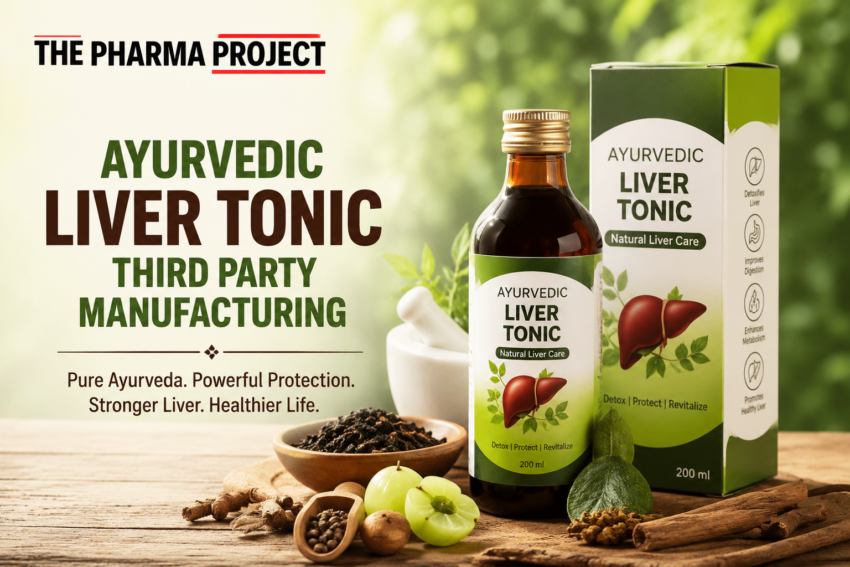
Ayurvedic Liver Tonic Third Party Manufacturing in India: 2026 Guide
Key Takeaways
- Compare at least 3 to 5 manufacturers on the same formula and pack specification.
- A trial commercial order may commonly start around 500 to 2,000 bottles, depending on factory and packaging MOQ.
- For a 200 ml bottle, commercial planning can vary from roughly ₹28 to ₹75+ depending on formula and pack.
- Verify at least 7 checkpoints, including licence, GMP, formula, COA, label, MOQ and payment terms.
- Keep the formula, bottle, cap, label and carton specification fixed before comparing quotations.
Launching an Ayurvedic liver tonic looks simple from the outside. Choose a formula, print a label, order bottles and start selling. In practice, the manufacturing decision has several moving parts.
Are you buying a classical Ayurvedic formulation or an Ayurvedic proprietary medicine? Which ingredients and quantities are being used? Does the manufacturer hold the relevant manufacturing permission? Who will approve the artwork? Is the bottle included in the quoted rate? And what happens when your second batch needs to match the first?
If you are searching for ayurvedic liver tonic third party manufacturing, these questions matter more than a WhatsApp message saying “best quality, lowest rate”. Your supplier needs to fit your product, market and order size.
India has established Ayurvedic manufacturing activity across places such as Haridwar, Baddi, Solan, Paonta Sahib, Ahmedabad and other industrial clusters. Brands including Dabur, Baidyanath, Himalaya, Patanjali, Zandu and Charak have also made Ayurvedic and herbal products familiar to Indian buyers. But a private-label launch has its own economics.
From our work around Zirakpur and the Baddi belt, we regularly see new buyers focus first on bottle price. Manufacturers, however, usually need the composition, pack size and quantity before a meaningful quote can be prepared. That small difference in approach can prevent a lot of back-and-forth.
What Exactly Is Ayurvedic Liver Tonic Third Party Manufacturing?
Ayurvedic liver tonic third party manufacturing is a business arrangement in which an Ayurvedic manufacturing unit produces a liver-support formulation for another company that markets the finished product under its own brand.
You don’t need to build your own syrup section, purchase mixing and filling equipment or operate an in-house quality-control setup. Instead, you select a suitable licensed manufacturer and agree on the formula, bottle size, packaging, batch quantity and commercial terms.
The manufacturer procures or issues approved raw materials, manufactures the batch, fills it, labels it and packs it according to the agreed specification. The exact responsibilities depend on your contract.
This model is popular with PCD businesses, Ayurvedic marketers, distributors and D2C founders because it lowers the capital required for a product launch. Our third party manufacturing resources explain the broader contract-manufacturing model.
But don’t confuse outsourcing with giving up control. You still need to know exactly what is being manufactured under your brand.
Why Does the Manufacturer Matter So Much in 2026?
The manufacturer matters because your formula consistency, documentation, packaging quality, repeat supply and regulatory compliance depend heavily on the unit producing the product.
Ayurvedic medicines in India operate under the legal and regulatory framework administered through the Ministry of AYUSH and state licensing authorities. For official policy and regulatory information, refer to the Ministry of AYUSH.
A low quotation is useful only when you know what it includes. Two suppliers can quote the same 200 ml liver tonic at very different prices because one uses a different extract profile, bottle, cap, carton board, label finish or order quantity.
Then there is repeatability. Suppose your first 1,500 bottles sell well. Can the manufacturer supply the same product again with consistent taste, colour, viscosity and packaging? Can it handle 5,000 bottles when your distribution expands?
This is why a factory relationship should be evaluated as a supply-chain decision, not a one-time purchase.
Which Ayurvedic Liver Tonic Formulations Can You Manufacture?
Manufacturers can offer classical or proprietary Ayurvedic liver-support formulations depending on their licence scope, approved products and technical capability.
| Product Direction | Common Ingredient Themes | Commercial Check |
|---|---|---|
| Herbal liver-support syrup | Kalmegh, Bhringraj, Bhumi Amla and other permitted herbs | Exact formula and approved claims |
| Multi-herb Ayurvedic tonic | Several extracts or decoction-based ingredients | Extract ratio, taste and sediment control |
| Sugar-based syrup | Herbal actives with conventional syrup base | Sugar content, viscosity and stability |
| Sugar-free positioned tonic | Alternative sweetening system | Formula review and claim support |
| Classical Ayurvedic preparation | Formula based on authoritative Ayurvedic text | Correct textual reference and process |
| Ayurvedic proprietary medicine | Permitted Ayurvedic ingredients in proprietary combination | Approved composition and label wording |
Don’t select ingredients only because they appear on a competitor’s carton. Your manufacturer should confirm the proposed formula and applicable product route before you commit to artwork.
Kalmegh, Bhringraj and Bhumi Amla are familiar names in the Ayurvedic market, but product positioning should stay within the approved and supportable claims for the actual formulation.
Which Manufacturing Options Should You Compare?
You should compare Ayurvedic liver tonic manufacturers by licence scope, syrup capability, formula support, testing, packaging, MOQ and repeat-order capacity.
| Factor | What to Ask | Why It Matters |
|---|---|---|
| Manufacturing status | Who is the actual licensed manufacturer? | Confirms the responsible production entity |
| Formula | Classical or proprietary? | Affects documentation and positioning |
| Batch capability | Minimum and maximum practical batch? | Important for growth planning |
| Testing | What does the batch COA contain? | Helps you assess release controls |
| Packaging | Bottle, cap, label, carton included? | Changes landed cost substantially |
| Lead time | New order versus repeat order? | Printed packaging can delay dispatch |
| Commercial terms | Advance, balance, GST and freight? | Prevents quotation surprises |
If your business is based around Chandigarh, Mohali, Zirakpur or Ambala, Baddi and nearby Himachal clusters can be convenient for visits and freight. Haridwar is another important Ayurvedic manufacturing location. Ahmedabad may make sense for brands with western India distribution.
Location matters, but capability matters more.
How Much Does Ayurvedic Liver Tonic Third Party Manufacturing Cost?
The manufacturing cost depends on the formulation, extract quality, bottle size, packaging, order quantity and testing, so there is no single correct per-bottle rate.
| Cost Component | Indicative Planning Range | Main Variable |
|---|---|---|
| 100 ml finished tonic | ₹18 to ₹48+ | Formula, bottle and order size |
| 200 ml finished tonic | ₹28 to ₹75+ | Herbal inputs, bottle, carton |
| 450 ml finished tonic | ₹58 to ₹135+ | Formula and packaging weight |
| PET bottle and cap | ₹5 to ₹16+ | Shape, gram weight, colour |
| Printed label | ₹1.20 to ₹5+ | Material and print quantity |
| Printed carton | ₹3 to ₹12+ | Board, finish and quantity |
| Artwork / printing setup | ₹1,500 to ₹9,500+ | Vendor and printing process |
| Freight | Destination based | Weight, distance and transporter |
These figures are planning ranges, not official fees or guaranteed quotations. A premium extract-heavy formula in a custom amber bottle can cost far more than a standard syrup in regular PET packaging.
Ask for the full finished-product rate. If one quotation excludes carton and freight while another includes both, comparing only the headline bottle price is pointless.
Send us your formula, bottle size and quantity. We reply within 24 hours.
What MOQ Should You Expect for Ayurvedic Liver Tonic?
A practical starting MOQ can range from roughly 500 to 2,000 bottles for some standard products, while custom formulas and packaging may require larger quantities.
| Order Type | Planning Quantity | What to Watch |
|---|---|---|
| Market test | 500 to 1,000 bottles | Higher unit packaging cost |
| Small PCD launch | 1,000 to 2,500 bottles | Distributor demand forecast |
| Regional brand | 2,500 to 5,000 bottles | Working capital and storage |
| Established marketer | 5,000+ bottles | Batch scheduling and repeat supply |
Packaging can create its own MOQ. A factory may agree to manufacture 1,000 bottles, but your custom bottle supplier or printed carton vendor may want a much larger run.
So ask separately about product MOQ and packaging MOQ.
How Do You Verify an Ayurvedic Liver Tonic Manufacturer?
You should verify the manufacturer’s licence, GMP status, product scope, formula documentation, testing system and commercial identity before placing a major order.
- Check the manufacturing licence. Match the legal entity and factory address.
- Confirm product scope. Ask whether your proposed liver tonic is covered under the unit’s approvals.
- Review GMP documentation. Understand the quality system followed by the plant.
- Ask for a sample COA. See what finished-product parameters are reported.
- Check the formula. Freeze ingredient names, quantities and product category before artwork.
- Verify packaging. Approve bottle, cap, label, carton and batch-coding area.
- Write down commercial terms. MOQ, GST, freight, advance, balance and dispatch timeline should be clear.
- Visit where practical. A physical visit can clarify capacity, hygiene, storage and production arrangements quickly.
For related industry updates, you can follow The Pharma Project’s pharma and manufacturing news.
What Is the Step-by-Step Manufacturing Process?
The process normally moves from product brief and formula approval to quotation, documentation, artwork, manufacturing, quality checks, packing and dispatch.
- Prepare your brief. Specify product type, formula preference, bottle size and target quantity.
- Shortlist 3 to 5 units. Send the same specification to each manufacturer.
- Review formula options. Compare ingredients, dosage directions, flavour and product category.
- Collect written quotations. Include bottle, label, carton, testing, taxes and freight assumptions.
- Verify documents. Check the manufacturing entity and relevant licence information.
- Approve sample and artwork. Freeze the technical and packaging details before printing.
- Issue purchase order. Record quantity, rate, payment schedule and dispatch terms.
- Manufacture and test. The unit processes the batch and performs its applicable quality checks.
- Pack and dispatch. Confirm batch details, quantity and documents before shipment.
For entrepreneurs building a wider product portfolio, our guide on how PCD pharma franchise works can help explain the distribution model.
Which Documents and Licences Matter?
The exact documents depend on the Ayurvedic product and business arrangement, but the manufacturing licence, product approval details, GMP documentation, formula, COA and approved artwork are central checks.
| Document | Purpose |
|---|---|
| Ayurvedic manufacturing licence | Identifies the licensed manufacturing entity |
| Applicable product approval / permission | Supports the specific product being manufactured |
| GMP certificate / status | Supports manufacturing quality-system verification |
| Master product specification | Defines formula and product parameters |
| Certificate of Analysis | Records batch test results |
| Approved label and carton artwork | Controls printed product information |
| Purchase order | Records quantity, rate and agreed packaging |
| GST and business details | Supports commercial verification |
The Ministry of AYUSH is the primary central reference point for Ayurveda policy and regulatory information. Don’t rely on a sales brochure as proof of licensing.
Which 6 Mistakes Should You Avoid?
The biggest mistakes are choosing only on price, copying competitor claims, ordering too much stock and failing to freeze the formula and packaging before production.
1. Asking Only for “Best Liver Tonic”
Give a proper brief. A manufacturer can’t quote accurately if the formula, bottle size and quantity are undefined.
2. Comparing Different Formulas
A basic herbal syrup and an extract-heavy proprietary formula aren’t commercially equivalent.
3. Copying Another Brand’s Artwork
Your product’s composition, manufacturer details and approved claims may differ. Build artwork around your actual product.
4. Ignoring Bottle Quality
Leakage, cap fit and transport damage can destroy margins. Ask for packaging samples.
5. Buying Too Much on the First Order
A lower unit price isn’t useful if half the stock remains unsold. Estimate realistic monthly movement.
6. Not Planning the Repeat Batch
Ask the manufacturer how quickly it can repeat the same product if your first batch moves faster than expected.
You can also explore our pharma franchise resources and export guides when planning wider distribution.
Share your formulation, pack size and expected order quantity for manufacturing options.
Frequently Asked Questions
1. What is Ayurvedic liver tonic third party manufacturing?
Ayurvedic liver tonic third party manufacturing means an appropriately licensed Ayurvedic manufacturer produces a liver-support tonic or syrup for another marketing company. The buyer can sell it under its brand subject to the agreed manufacturing, product, labelling and commercial arrangements. Formula, bottle size and quantity are normally finalised before production.
2. What is the MOQ for Ayurvedic liver tonic?
MOQ varies by manufacturer, formula and packaging. Some standard products may be discussed from around 500 to 2,000 bottles, while custom formulations, special bottles or printed components can require more. Confirm both the manufacturing MOQ and packaging MOQ because they may be different.
3. How much does a 200 ml Ayurvedic liver tonic cost to manufacture?
A commercial planning range for a 200 ml finished bottle may be around ₹28 to ₹75 or more, depending on formula, herbal inputs, bottle, cap, label, carton and quantity. This is not an official rate. Always request a written quotation against your exact specification.
4. Do I need my own Ayurvedic manufacturing plant?
No. Third party manufacturing is specifically useful for marketers that don’t operate their own manufacturing facility. You can work with a suitable licensed Ayurvedic unit and focus on branding and distribution, while the manufacturer handles production according to the agreed product and regulatory requirements.
5. Can I launch the liver tonic under my own brand?
Yes, own-brand products are commonly produced through contract manufacturing arrangements. Before printing your label, confirm the formula, manufacturing details, marketer information, approved product name and claims with the manufacturer. Brand or trademark availability should also be checked separately before investing in packaging.
6. What should I check in an Ayurvedic manufacturer?
Check the legal manufacturing entity, factory address, relevant manufacturing licence, product scope, GMP status, sample COA, packaging capability and commercial terms. For a serious long-term order, a factory visit can also help you understand production, storage, quality-control and dispatch arrangements.
7. Can a manufacturer provide a ready liver tonic formula?
Many Ayurvedic manufacturers have existing product portfolios and may offer standard or approved formulation options. Ask whether the formula is classical or proprietary, which ingredients and quantities it contains, what claims are permitted and whether the same product can be supplied consistently in future batches.
8. How long does manufacturing take?
Lead time depends on raw materials, bottle and carton availability, artwork approval, production schedule and testing. Repeat batches with ready packaging may move faster than a new product. Ask for a written dispatch estimate after the formula, quantity, artwork and payment terms are finalised.
9. Which bottle size is best for a liver tonic?
100 ml, 200 ml and larger family-size packs can all work depending on your price point and distribution channel. A 200 ml bottle is a familiar commercial format, but your decision should consider dosage directions, MRP, freight, retailer preference and expected consumer usage period.
10. Where can I get manufacturing quotations?
Prepare one brief containing the formula or ingredient direction, bottle size, quantity, packaging preference and delivery city. Send the same brief to multiple manufacturers for a fair comparison. You can also get a free manufacturing quote through The Pharma Project.
Conclusion: How Should You Choose a Manufacturer?
The right Ayurvedic liver tonic manufacturer should give you three things: a clearly defined product, verifiable manufacturing documentation and a quotation that explains the complete finished-pack cost.
Start by freezing the formula and bottle size. Then verify the manufacturer and relevant product documentation. Finally, compare at least three quotations on the same specification.
Don’t let a ₹3 or ₹4 difference per bottle make the entire decision for you. Packaging consistency, repeat supply, documentation and communication can matter far more once your product reaches distributors.
If you’re preparing an Ayurvedic liver tonic launch, send the formula direction, bottle size and expected quantity through our manufacturing enquiry page. A structured brief makes it much easier to compare suitable options.
Read our full Disclaimer and Editorial Policy.