
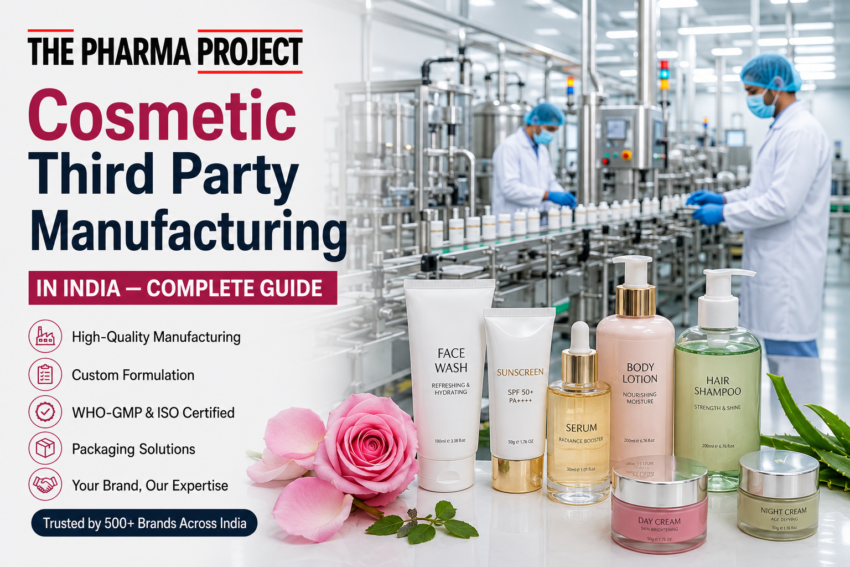
Cosmetic Third Party Manufacturing in India: Complete 2026 Guide
Cosmetic third party manufacturing in India allows you to sell skincare, hair care, personal care or beauty products under your own brand while a licensed factory handles production. Typical starting MOQs range from 500 to 3,000 units per SKU, depending on formulation and packaging. A focused launch usually needs ₹1.35 lakh to ₹6.75 lakh and takes roughly 30 to 75 days after formula, artwork and packaging approval.
Key Takeaways
- Standard private-label MOQs commonly start near 500 to 1,000 units per product, while custom formulas may need 2,000 units or more.
- A practical three-product launch can require approximately ₹2.4 lakh to ₹8.8 lakh, including packaging and basic testing.
- Cosmetic manufacturing licences in India are generally issued by the relevant State Licensing Authority.
- A repeat formula with available packaging may move in 30 to 45 days. New formulation and custom mould work can stretch beyond 75 days.
- Online beauty sales in India grew 39% in value between June and November 2024, according to an IBEF report citing NielsenIQ.
Launching a cosmetic brand looks easy on Instagram. Pick a serum, print a premium label, run ads, and orders should arrive. Right?
Not quite.
The real work starts before the first bottle reaches your warehouse. You need a manufacturer who can produce consistent batches, source stable packaging, print compliant labels, meet your MOQ and still leave enough margin for advertising, distributor discounts and returns. That is why cosmetic third party manufacturing in India has become a practical route for D2C founders, salon owners, pharma marketers and entrepreneurs who don’t want to build a factory.
Demand is clearly moving. An IBEF report published in 2025 said online beauty and personal care sales increased 39% in value between June and November 2024, compared with 3% growth in physical stores. But growth doesn’t protect a weak product. One leaking pump or unstable cream can damage months of brand work.
This guide explains how the model works, product categories, realistic MOQs, commercial cost ranges, licence checks, documentation, timelines and common mistakes. You’ll also see what to ask before sending an advance. Because the cheapest quotation isn’t always the cheapest decision.
What Exactly Is Cosmetic Third Party Manufacturing in India?
Cosmetic third party manufacturing is an arrangement where a licensed manufacturer produces cosmetic products for your brand according to an approved formula, packaging specification and commercial agreement.
You own the brand. The manufacturer owns or operates the production facility. It purchases or receives raw materials, processes the batch, fills the product, performs quality checks and packs the finished goods. Your name appears as the marketer, while the factory details and manufacturing licence information appear on the label as required.
This model is also called contract manufacturing, private-label manufacturing or loan-licence manufacturing in different business conversations, though these terms aren’t always legally identical. Clarify the exact arrangement before signing anything.
Suppose you want to launch a face wash, vitamin C serum and sunscreen. You can ask an existing manufacturer to offer tested base formulations, choose containers, approve fragrances and provide your artwork. You avoid the cost of land, machinery, technical staff and production approvals. That lets you focus on positioning, distribution and sales.
But you don’t outsource responsibility for the brand. Customers call you when a pump stops working. Marketplaces question you if label claims look doubtful. And if two batches feel noticeably different, your reviews will show it.
Why Does Cosmetic Contract Manufacturing Matter in 2026?
Cosmetic contract manufacturing matters in 2026 because it lets founders enter a growing beauty market without committing several crores to their own plant.
India’s beauty market has moved beyond basic cold cream, shampoo and talcum powder. Customers now compare niacinamide percentages, sunscreen texture, sulphate-free claims, fragrance notes and ingredient transparency. Established names such as Dabur, Himalaya, Patanjali and Zandu helped expand herbal and personal-care awareness, while digital-first brands trained buyers to expect targeted products.
IBEF reported in 2025 that India’s online beauty market was the fastest-growing online beauty market, with beauty e-commerce and quick-commerce sales rising sharply during 2024. That creates room for new brands, but it also raises the performance bar. You aren’t competing only on MRP. You’re competing on texture, packaging, delivery speed, reviews and repeat purchase.
A contract manufacturer helps you test the market with limited SKUs. You can begin with two strong products instead of launching 18 average ones. You can also change packaging on the next batch without scrapping installed machinery.
The model fits D2C founders, salon chains, pharma marketers, influencers, exporters and regional distributors. If you are comparing this model with pharmaceutical outsourcing, the broader third party manufacturing resource section explains how contract production differs across regulated categories. For franchise-led distribution, review how the PCD pharma franchise model works.
Which Cosmetic Products Can You Manufacture Under Your Brand?
You can manufacture skincare, hair care, body care, hygiene, colour cosmetics and selected herbal personal-care products under your brand, subject to the manufacturer’s approved product scope.
| Category | Popular Products | Typical MOQ Per SKU | Difficulty | Best Fit |
|---|---|---|---|---|
| Skincare | Face wash, moisturiser, serum, toner, scrub, mask | 500 to 2,000 | Medium | D2C and salon brands |
| Hair care | Shampoo, conditioner, hair oil, serum, mask | 500 to 3,000 | Low to medium | Retail networks |
| Body care | Body lotion, wash, scrub, butter | 500 to 2,000 | Low to medium | Wellness brands |
| Personal hygiene | Hand wash, intimate wash, deodorant | 1,000 to 5,000 | Medium | Mass market |
| Colour cosmetics | Lipstick, kajal, foundation, compact | 1,000 to 5,000 | High | Beauty-first brands |
| Herbal cosmetics | Neem face wash, aloe gel, ubtan, herbal hair oil | 500 to 2,500 | Medium | Natural-positioned brands |
Don’t select a product only because a factory offers it cheaply. Ask whether your audience actually needs it. A 30 ml serum can deliver attractive gross margins, but the category also faces intense advertising competition. A salon shampoo may generate repeat orders with lower digital ad costs if you already have professional distribution.
For ingredient-led content planning, the existing article on vitamin B12 uses shows how ingredient education supports search demand, although cosmetic claims and medicine claims must remain clearly separated.
Should You Choose Private Label or Custom Formulation?
Choose private label for a faster, lower-risk launch, and choose custom formulation only when product differentiation justifies extra development time and higher MOQ.
| Factor | Private Label Formula | Custom Formulation |
|---|---|---|
| Formula | Existing formula with limited changes | Developed against your brief |
| Launch time | 30 to 45 days | 60 to 120 days |
| Development cost | ₹2,500 to ₹12,500 | ₹18,500 to ₹95,000 |
| Likely MOQ | 500 to 1,500 units | 2,000 to 10,000 units |
| Differentiation | Packaging and positioning | Ingredients, texture and performance |
| Best for | First launch | Funded brands with a clear gap |
Many first-time founders demand a unique formula before they have sold one bottle. Why pay for six rounds of development if you haven’t tested your price point or audience?
A sensible path is to begin with a proven base, improve fragrance or texture where permitted, and invest more energy in packaging, education and repeat purchase. Custom formulation makes sense when you can define target texture, colour, fragrance, hero ingredients, excluded ingredients, pack type, target cost and supportable claims.
What MOQ Should You Expect for Cosmetic Third Party Manufacturing in India?
Most manufacturers quote an MOQ between 500 and 3,000 finished units per SKU, but packaging, formula complexity and batch size can move the number substantially.
MOQ means minimum order quantity. It is the smallest commercially workable batch a manufacturer agrees to produce. There may be separate MOQs for bulk product, bottles, pumps, cartons, labels and printed laminates.
| Product | Common Launch MOQ | Indicative Ex-Factory Range | Main Cost Driver |
|---|---|---|---|
| 100 ml face wash | 1,000 units | ₹42 to ₹86 | Actives and pump |
| 30 ml facial serum | 500 to 1,000 | ₹58 to ₹148 | Actives and glass |
| 200 ml shampoo | 1,000 to 3,000 | ₹54 to ₹112 | Surfactants and bottle |
| 50 g cream | 500 to 1,500 | ₹62 to ₹156 | Jar, carton and formula |
| 100 ml hair oil | 1,000 units | ₹46 to ₹118 | Oil blend and bottle |
| 100 g soap | 2,000 to 5,000 | ₹24 to ₹58 | Base, wrap and carton |
These are commercial planning ranges, not statutory prices. Your actual quote can be lower or higher.
One hidden issue is component MOQ. A manufacturer may agree to make 500 serum units, but the selected printed bottle supplier may demand 3,000 pieces. You then have three choices: hold extra packaging, use labels instead of direct printing, or select a stock bottle.
From my work with manufacturing businesses around Zirakpur and the Baddi belt, I’ve repeatedly seen new buyers negotiate hard on the product MOQ while ignoring the packaging MOQ. The discussion changes only after the bottle vendor asks for a much larger print run. Ask both questions on day one.
How Much Does Cosmetic Third Party Manufacturing Cost in 2026?
A realistic small cosmetic brand launch in 2026 can cost ₹1.35 lakh to ₹8.8 lakh, depending on SKU count, MOQ, packaging and formula development.
| Cost Head | Lean Private-Label Launch | Premium Custom Launch | Cost Driver |
|---|---|---|---|
| Sampling and development | ₹5,500 to ₹22,000 | ₹55,000 to ₹1,85,000 | Revisions and testing |
| Finished inventory | ₹78,000 to ₹2,45,000 | ₹3,20,000 to ₹7,50,000 | MOQ and packaging |
| Artwork | ₹6,500 to ₹28,500 | ₹35,000 to ₹1,20,000 | SKUs and branding |
| Testing and documents | ₹9,500 to ₹38,000 | ₹45,000 to ₹1,60,000 | Product and reports |
| Freight and handling | ₹4,500 to ₹26,000 | ₹28,000 to ₹95,000 | Distance and cartons |
Suppose you launch 1,000 units each of a face wash, serum and moisturiser. At average landed inventory costs of ₹68, ₹112 and ₹126, finished stock alone comes to ₹3,06,000. Add design adaptation, samples, cartons, freight and testing, and your pre-marketing spend may reach roughly ₹3.72 lakh to ₹4.46 lakh.
If the serum lands at ₹112 and sells at ₹699, the spread looks attractive. But subtract GST treatment, marketplace commission, shipping, warehousing, discounts, returns, samples and paid media. A headline markup isn’t final profit. Many online beauty brands need a 42% to 58% gross contribution before advertising to create enough room for customer acquisition.
And don’t spend everything on inventory. Keep cash for content, marketplace onboarding, replacement stock and the second batch. A brand with 5,000 bottles and no marketing budget doesn’t have scale. It has storage.
Which Licences and Documents Matter for Cosmetic Manufacturing?
A compliant arrangement requires a valid cosmetic manufacturing setup, approved product scope, correct label information and a clear commercial agreement between you and the manufacturer.
India’s Cosmetics Rules, 2020 published by CDSCO provide the central regulatory framework for cosmetics. CDSCO guidance states that domestic cosmetic manufacturing licences are issued by the respective State Licensing Authorities.
- Manufacturing licence: Check the number, authority, validity and approved categories.
- Approved product scope: Confirm the proposed format is covered.
- GST and business records: Keep PAN, GST and billing details ready.
- Trademark: Protect the brand before printing large quantities.
- Manufacturing agreement: Define formula ownership, quality, payment, lead time and rejection handling.
- Artwork approval: Verify MRP, net content, batch fields, manufacturer, marketer and customer-care details.
- Testing records: Ask which microbial, stability or compatibility checks apply.
The Central Drugs Standard Control Organisation is the national regulatory authority, while state authorities generally handle domestic cosmetic manufacturing licensing. Imported cosmetics follow a different route.
Some founders use words such as herbal, Ayurvedic, organic or medicated too casually. The Ministry of AYUSH regulates Ayurveda, Siddha, Unani and Homoeopathy systems, but not every botanical cosmetic automatically becomes an AYUSH product.
For products near a drug-cosmetic boundary, review intended claims carefully. The site’s drug information section shows why regulated claims require separate handling.
How Do You Verify a Cosmetic Third Party Manufacturer?
You verify a cosmetic manufacturer by checking its licence, approved scope, production capability, quality records, samples, packaging controls and response discipline before paying a major advance.
- Match the legal name. Licence, invoice, bank account and agreement should align.
- Read the licence scope. One approved format does not prove capability for every cosmetic.
- Request recent samples. Check smell, texture, colour, fill, seal and pump output.
- Ask for the batch process. Understand raw-material approval and in-process checks.
- Inspect packaging storage. Open or dusty components create avoidable risk.
- Check complaint handling. Ask what happens after leakage, shortage or variation.
- Confirm testing responsibility. Separate included tests from paid tests.
- Understand subcontracting. Know where the product is actually made.
- Visit the unit. A one-day visit can reveal more than 40 messages.
The WHO explanation of Good Manufacturing Practice describes GMP as a system covering production, quality control, contract manufacturing, testing and complaint response. WHO GMP documents primarily address health products, so don’t treat a generic logo as proof of a cosmetic unit’s exact approval. Verify scope.
You can also review this overview of an MDI manufacturer in Baddi to see how facility capability differs by dosage form.
What Is the 7-Step Cosmetic Manufacturing Process?
The cosmetic manufacturing process moves from product brief to sampling, commercial approval, documentation, packaging, production and final dispatch.
1. Create a Specific Product Brief
State product type, pack size, target buyer, price point, fragrance, colour, hero ingredients, excluded ingredients, expected MOQ and target cost. “Need best face wash” isn’t a useful brief.
2. Shortlist Two to Four Manufacturers
Compare capability, not only quotation. Ask whether the unit routinely makes your product format.
3. Approve Samples
Test two or three samples and record feedback in writing. Check again after several days because fragrance, colour and viscosity can change.
4. Freeze the Commercials
Confirm unit price, GST, freight, packaging, testing, breakage policy, payment, lead time and quote validity.
5. Finalise Artwork and Claims
Review spelling, net quantity, usage directions, cautions and claims. One typo multiplied by 3,000 cartons becomes expensive.
6. Production, Filling and Quality Checks
The unit procures material, makes the batch, performs checks, fills and packs according to approval.
7. Dispatch and Batch Record Collection
Verify quantities and collect invoice, batch details, agreed reports, transport documents and final artwork. Store one sealed control sample.
Standard private-label orders may finish in 30 to 45 days after approvals. Custom printed packaging often adds time.
Which Indian Manufacturing Locations Should You Consider?
Baddi, Solan, Zirakpur, Haridwar, Ambala, Paonta Sahib, Ahmedabad and selected industrial clusters in Sikkim offer different combinations of manufacturing capacity, suppliers and logistics.
Baddi and Solan: The Himachal belt has a deep pharmaceutical and personal-care supplier network and is convenient for buyers from Chandigarh, Punjab, Haryana and Delhi NCR.
Zirakpur and Ambala: These cities work well as commercial coordination and distribution points for nearby manufacturing belts.
Haridwar: Haridwar has a large FMCG, herbal, Ayurvedic and personal-care ecosystem and can suit higher-volume hair oil, shampoo and body care.
Paonta Sahib: Paonta Sahib has established manufacturing activity. Evaluate each unit’s cosmetic scope rather than relying on location alone.
Ahmedabad: Gujarat offers strong chemical, packaging, pharmaceutical and cosmetic supply chains.
Sikkim: Sikkim is associated mainly with pharmaceutical manufacturing. Compare cosmetic capability and logistics carefully.
Keep an eye on developments through pharma news updates. Export-focused founders should also review the pharmaceutical and healthcare export section, then confirm cosmetic-specific destination requirements separately.
Which Mistakes Cost New Cosmetic Brands the Most Money?
The costliest mistakes are ordering too many SKUs, choosing packaging before formula compatibility, accepting vague claims, ignoring landed cost and paying advances without complete written terms.
1. Launching Too Many Products
Eight SKUs split your cash, reviews and ad budget eight ways. Start with one hero product and one or two supporting products.
2. Selecting the Cheapest Pump or Jar
Packaging is part of performance. Test the actual bulk formula in the final pack.
3. Copying Competitor Claims
Don’t copy “clinically proven,” “100% safe,” “chemical-free” or treatment-style claims without evidence.
4. Ignoring Full Landed Cost
Your ₹74 factory rate may become ₹96 after cartons, freight, handling and damage allowance.
5. Approving Artwork on a Phone
Print the label at actual size. Tiny directions may become unreadable.
6. Paying Without Milestones
Link payments to documented stages where commercially possible.
7. Treating Samples as Final Batch Proof
A hand-made lab sample and a large production batch aren’t the same event.
8. Depending on One Supplier for Everything
Keep your approved artwork, dielines, shade references and product specification.
For a structured quotation discussion, you can get a free manufacturing quote by sharing product category, quantity, pack size and target market.
Frequently Asked Questions About Cosmetic Third Party Manufacturing in India
These answers cover the practical questions founders usually ask before placing their first cosmetic manufacturing order.
What is cosmetic third party manufacturing in India?
It means a licensed manufacturing unit produces skincare, hair-care, beauty or personal-care products for another company’s brand. The factory handles agreed production, filling, checks and packing, while the brand owner manages positioning and sales.
What is the minimum order quantity for private-label cosmetics?
The common starting MOQ is about 500 to 3,000 units per SKU. Serums and creams may begin near 500 units with stock packaging, while shampoos, soaps, printed tubes and colour cosmetics often require larger runs.
How much money is needed to start a cosmetic brand in India?
A focused private-label launch can begin around ₹1.35 lakh to ₹3.8 lakh, while a three-product premium launch may need ₹4 lakh to ₹8.8 lakh before substantial marketing.
How long does cosmetic third party manufacturing take?
An existing formula with stock packaging may take roughly 30 to 45 days after approvals. Custom formulas, stability work, imported pumps or printed containers can push the timeline to 60 to 120 days.
Who issues cosmetic manufacturing licences in India?
Cosmetic manufacturing licences for domestic production are generally issued by the respective State Licensing Authorities under India’s Cosmetics Rules framework. Check validity, address, legal name and authorised product categories.
Can I sell cosmetics under my brand without owning a factory?
Yes. You can use a licensed third party manufacturer without owning production machinery. You still need proper business documents, compliant artwork and a written agreement.
Is private label the same as custom cosmetic manufacturing?
No. Private label usually uses an existing formula with limited changes. Custom manufacturing starts from a detailed product brief and may involve several sampling rounds, higher charges and longer validation.
Which cosmetic products are easiest for a new brand to launch?
Face wash, shampoo, hair oil, body lotion and basic moisturisers are usually easier because many manufacturers already have established formulas and packaging options.
What should I check before paying a cosmetic manufacturer?
Check the manufacturing licence, approved scope, sample, final packaging specification, testing responsibility, quotation, tax treatment, payment schedule, production timeline and complaint policy.
Can an Indian cosmetic manufacturer produce products for export?
Many Indian manufacturers support exports, but destination-country requirements differ. You may need additional product files, ingredient restrictions, certificates, stability evidence or market-specific labels.
Conclusion: Build the Brand Around One Repeatable Product
Cosmetic third party manufacturing in India gives you a practical way to enter the beauty market without owning a factory. Keep the first range focused, calculate the full landed cost rather than the factory rate, and verify the unit’s licence, approved scope and batch controls before paying a major advance.
Your initial MOQ may sit between 500 and 3,000 units per SKU. Your launch may take 30 to 75 days. And your first inventory commitment may range from ₹1.35 lakh to ₹8.8 lakh, depending on formula and packaging.
Start small enough to learn, but not so cheaply that the product disappoints customers. A strong bottle cannot rescue a weak formula. A strong formula cannot rescue a leaking pump. You need both.
Prepare a clear brief, compare two to four qualified manufacturers, test samples in final packaging and document every approval. That is slower than sending an advance after one WhatsApp quotation. It is also far safer.
Read our full Disclaimer and Editorial Policy.