
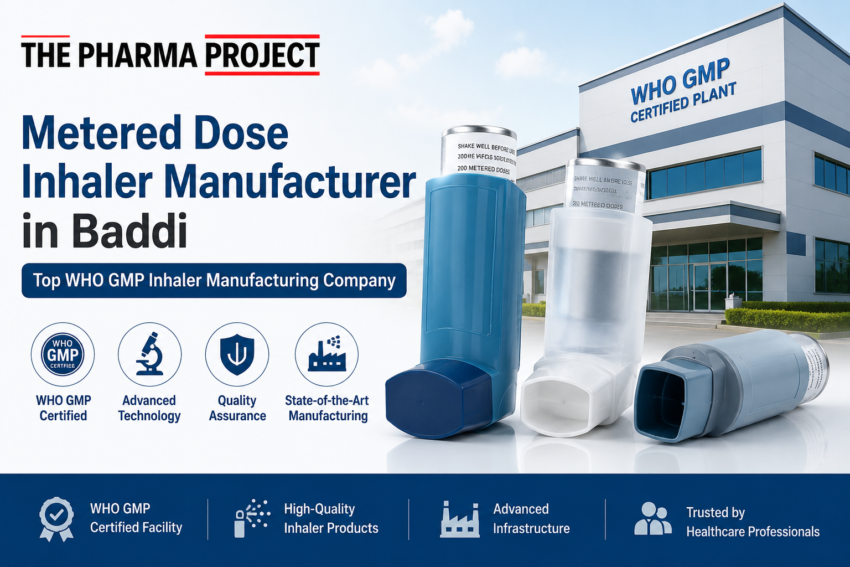
MDI Manufacturer in Baddi: Cost, MOQ, Process and Verification Guide 2026
Quick Answer: An MDI manufacturer in Baddi produces pressurised metered-dose inhalers using specialised formulation, aerosol filling, crimping, leak testing and dose-delivery controls. In 2026, a practical third-party MOQ often starts around 5,000 to 25,000 inhalers per product, while commercial cost can range from roughly ₹72 to ₹245 per unit depending on the molecule, valve, actuator, canister, propellant, testing and pack. Verify licences, product permission, GMP status and inhalation testing capability before paying.
Key Takeaways
- Commercial MDI orders commonly begin near 5,000 to 25,000 inhalers per formulation, although specialised combinations may need a larger batch.
- Indicative manufacturing cost can range from ₹72 to ₹245 per inhaler before GST, freight and one-time development charges.
- A first production cycle may take 45 to 75 days because valves, canisters, actuators, artwork and analytical checks require coordination.
- Ask for at least 10 compliance and quality records, including the drug licence, product permission, GMP certificate and batch COA format.
- IBEF estimates India’s pharmaceutical market at about ₹5,20,000 crore in 2026, supporting a deep manufacturing and supplier ecosystem.
Metered-dose inhalers look simple from the outside. They aren’t.
A tablet line can often be understood by looking at granulation, compression and packing. An MDI line is different. You are dealing with a drug formulation, a pressurised container, a metering valve, an actuator, a propellant, dose uniformity and performance testing that directly affect how the product delivers medicine. That is why selecting an MDI Manufacturer in Baddi requires more than comparing a product list and a WhatsApp quotation.
What exactly is MDI manufacturing?
MDI manufacturing is the controlled production of a pressurised inhalation medicine that delivers a measured quantity of formulation with each actuation.
A metered-dose inhaler is a drug-device combination in which a formulation is filled into a pressurised canister fitted with a metering valve and actuator. Each actuation must release a controlled dose within the approved specification. The finished inhaler may contain a suspension or solution formulation depending on the molecule and product design.
The manufacturing scope generally includes raw-material dispensing, formulation preparation, canister filling, valve placement, crimping, pressure or leak checks, actuator assembly, labelling, carton packing and quality testing. Some products also require specialised particle-size or aerodynamic performance studies.
Many respiratory products fall under prescription medicine controls. Before building a portfolio, read our guide to the Schedule H drugs list to understand why product marketing and distribution need regulatory care.
Why should you choose an MDI manufacturer in Baddi in 2026?
Baddi offers a concentrated pharma ecosystem, easier North India coordination and access to packaging, logistics and technical support, but you must confirm that the chosen unit has real inhalation capability.
IBEF estimates the Indian pharmaceutical market at approximately ₹5,20,000 crore in 2026. That scale supports manufacturing clusters across Himachal Pradesh, Uttarakhand, Gujarat, Telangana and Sikkim. You can review the wider market context through IBEF’s pharmaceutical industry analysis.
From our work with pharmaceutical companies across the Zirakpur and Baddi belt, we have noticed one recurring pattern: serious respiratory buyers ask about valves, canisters, product permissions and testing before they ask for the final rate. Buyers who start only with “best price” usually discover hidden technical differences much later.
Baddi also supports wider PCD and third-party business models. If you are new to distribution, our article on how PCD pharma franchise works explains the commercial structure in simple terms.
Which MDI products can a Baddi inhaler unit manufacture?
A capable unit may manufacture bronchodilator, corticosteroid and combination MDIs, subject to approved facility design, product permission and technical capability.
| MDI category | Typical formulation example | Commercial complexity | MOQ signal |
|---|---|---|---|
| Short-acting bronchodilator | Salbutamol type products | Moderate | 5,000 to 15,000 inhalers |
| Anticholinergic inhaler | Ipratropium type products | Moderate | 8,000 to 20,000 inhalers |
| Inhaled corticosteroid | Budesonide or beclometasone type products | High | 10,000 to 25,000 inhalers |
| LABA inhaler | Formoterol type formulations | High | 10,000 to 25,000 inhalers |
| Combination MDI | Corticosteroid plus bronchodilator | High to very high | 15,000 to 40,000 inhalers |
| Export-specific MDI | Country-approved respiratory portfolio | Very high | 25,000 units and above |
Which MDI manufacturing option suits your business best?
Your best option depends on whether you need a ready composition, a new brand, a custom formulation, export documentation or a complete respiratory portfolio.
| Manufacturing model | Best for | Speed | Main risk |
|---|---|---|---|
| Ready-composition third party | PCD companies and first-time marketers | Fastest | Limited differentiation |
| Private label MDI | Businesses launching under their own brand | Moderate | Artwork and trademark delays |
| Custom formulation development | Established companies with technical plans | Slow | Development, stability and permission cost |
| Loan licence arrangement | Businesses with regulatory and technical teams | Moderate to slow | More documentation and compliance responsibility |
| Export contract manufacturing | Registered overseas brands and distributors | Slowest | Country-specific dossier and testing requirements |
How much do MDI manufacturing and MOQ cost in Baddi?
MDI manufacturing can cost roughly ₹72 to ₹245 per inhaler, while common third-party MOQs range from 5,000 to 25,000 units per formulation.
| Cost component | Indicative 2026 range | What changes the rate |
|---|---|---|
| Basic bronchodilator MDI | ₹72 to ₹128 per inhaler | Molecule, dose count, valve and canister |
| Corticosteroid MDI | ₹105 to ₹178 per inhaler | API cost, suspension control and testing |
| Combination MDI | ₹138 to ₹245 per inhaler | Two APIs, analytical complexity and product design |
| Printed carton | ₹4.80 to ₹12.50 per unit | Board, lamination, colours and quantity |
| Leaflet | ₹0.85 to ₹2.40 per unit | Paper size, folds and print volume |
| Artwork and setup | ₹6,500 to ₹24,500 per SKU | Design, printing plates and component printing |
| Special analytical or performance testing | ₹18,500 to ₹85,000 per requirement | Method, lab, stages and product complexity |
Suppose you order 10,000 inhalers at ₹112 per unit. The manufacturing value is ₹11,20,000 before GST, freight, artwork and any one-time testing. If your carton, leaflet and transport add ₹11.70 per unit, your landed pre-tax value moves closer to ₹12,37,000.
Ask whether the quotation includes the canister, metering valve, actuator, dust cap, label, carton, leaflet, testing, retention samples, freight and GST. Also confirm the number of labelled actuations. A 120-dose pack and a 200-dose pack are not the same commercial product.
Send your formulation, dose count and quantity. We reply within 24 hours.
How do you verify an MDI manufacturer in Baddi before payment?
You should verify the facility’s legal permissions, inhalation capability, component controls, quality records and commercial terms before releasing a large advance.
- Manufacturing licence: Match the legal name, address, dosage form and validity with the contracting company.
- Product permission: Confirm the exact composition, strength, dose count and approved pack where applicable.
- GMP certificate: Review the current certificate and issuing authority. WHO explains that GMP requires controlled production and quality systems.
- Aerosol filling area: Ask for a plant visit or live video showing filling, crimping and testing equipment.
- Component suppliers: Request specifications for canisters, valves, actuators and caps.
- Testing capability: Ask which tests are in-house and which are outsourced to an approved laboratory.
- Sample COA: Check whether the document includes product-specific performance and release tests.
- Stability support: Confirm available stability data and storage conditions for the proposed pack.
- Deviation handling: Ask how leaks, crimp problems, dose failures and rejected components are investigated.
- Commercial agreement: Define advance, balance payment, delivery, rejection, unused packaging and brand ownership.
The Central Drugs Standard Control Organisation is India’s national regulatory authority and coordinates drug standards and state regulatory activities. Manufacturing permissions can involve state licensing authorities, so a CDSCO logo on a brochure does not prove that a factory can make your exact MDI.
What is the seven-step MDI manufacturing process?
The MDI manufacturing process moves from formulation and component approval to filling, crimping, performance testing, packing and documented release.
- Finalise the formulation and dose count.
Confirm the active ingredient, strength per actuation, number of actuations, propellant system, canister size, valve and actuator design. - Check regulatory permission.
The manufacturer must confirm whether the product already has permission or requires a new approval route under applicable drug rules. CDSCO publishes the Drugs Rules and regulatory references. - Approve the quotation and specifications.
Freeze the product, component sources, pack, number of actuations, testing, taxes, freight, payment and timeline. - Prepare formulation and components.
The quality team checks APIs, excipients, propellant, canisters, valves and actuators against approved specifications. - Fill, valve and crimp the canister.
The facility fills the formulation using its approved process, places the metering valve and crimps the assembly under controlled conditions. - Perform in-process and finished-product tests.
Checks may include fill weight, crimp dimensions, leak rate, valve performance, delivered dose and other product-specific tests. - Assemble, pack and release.
The actuator and cap are fitted, labels and cartons are applied, and the quality unit releases the batch after reviewing results and documents.
Which licences and documents are required for MDI third-party manufacturing?
You need valid business documents for the marketing company, manufacturing permissions for the factory, product-specific approval and a written agreement between both parties.
| Document | Provided by | Purpose |
|---|---|---|
| GST registration | Brand owner and manufacturer | Commercial invoicing and tax compliance |
| Company constitution documents | Brand owner | Legal identity and authorised signatory |
| Trademark application or registration | Brand owner | Brand protection |
| Drug manufacturing licence | Manufacturer | Authority to manufacture the dosage form |
| GMP certificate | Manufacturer | Quality-system evidence |
| Product permission | Manufacturer | Approval for the specific formulation |
| Third-party manufacturing agreement | Both parties | Commercial and quality responsibilities |
| Artwork approval | Both parties | Final legal and commercial pack text |
| Certificate of Analysis | Manufacturer’s quality unit | Batch release test results |
| Export dossier documents | Manufacturer and exporter | Country registration and shipment support |
Export orders can require country-specific dossiers, legalised certificates, stability data and additional analytical studies. Pharmexcil represents the Indian pharmaceutical export sector, and you can review Pharmexcil’s official export resources for current industry information.
For wider export planning, see our pharmaceutical export category.
Which quality tests matter most for an MDI product?
The most important checks evaluate dose delivery, canister integrity, valve performance, formulation quality and product consistency across the labelled life of the inhaler.
- Identification and assay: Confirms the active ingredient and its quantity.
- Delivered dose uniformity: Checks whether actuations deliver a consistent amount within specification.
- Aerodynamic particle performance: Evaluates the fraction and distribution of particles relevant to inhalation delivery.
- Leak rate: Detects loss of propellant or pressure from the sealed canister.
- Crimp dimensions: Confirms that the valve and canister seal are formed correctly.
- Number of actuations: Verifies that the pack can deliver the labelled dose count.
- Moisture or impurity testing: Applied according to the formulation and approved specification.
- Valve discharge or shot weight: Helps assess metering consistency.
- Appearance and spray pattern: Supports physical assessment, although it cannot replace performance testing.
- Stability studies: Confirm performance under approved storage conditions over time.
WHO guidance treats GMP as part of a wider quality-assurance system. That means you should review controls for people, premises, equipment, materials, written procedures and batch records, not only the finished COA.
Our pharma news section covers regulatory and manufacturing developments, while the pharma API category is useful when you are studying ingredient and supply-side issues.
Which six mistakes increase MDI cost or delay dispatch?
The biggest mistakes are comparing incomplete quotations, ignoring component specifications, approving artwork too early, promising unrealistic delivery, weak documentation and ordering too many products.
1. Comparing only the final rate
A quote at ₹96 may exclude cartons, leaflets, testing or freight, while a ₹111 quote may include them. Ask for a line-by-line commercial sheet.
2. Ignoring the valve and actuator
The component system affects dose delivery and user experience. “Same medicine” does not mean “same inhaler.”
3. Approving print before permission confirmation
One artwork change after printing can create ₹28,500 of unusable cartons and labels. Freeze legal text first.
4. Assuming a 20-day first batch
Canister sourcing, valve supply, analytical work and production planning take time. Build a 45 to 75-day launch window unless written material availability supports faster delivery.
5. Paying without rejection terms
Your agreement should define what happens if the batch fails, components leak or the delivered pack differs from the approved specification.
6. Launching a full respiratory range at once
Four products at 10,000 units each can block more than ₹40 lakh depending on the mix. Start with the products your sales team can actually move.
Share your molecule, dose count and target quantity for practical sourcing support.
Frequently Asked Questions About MDI Manufacturers in Baddi
What is the minimum order quantity for MDI manufacturing in Baddi?
A practical MOQ often starts around 5,000 to 25,000 inhalers per formulation. The final figure depends on the validated batch size, valve and canister minimums, product permission, dose count and packaging quantity. Combination inhalers or special component systems may require 15,000 to 40,000 units.
How much does one MDI cost in third-party manufacturing?
An MDI may cost approximately ₹72 to ₹245 per unit before GST and freight. Basic bronchodilator inhalers usually fall toward the lower end, while corticosteroid and combination products cost more. Valve, actuator, canister, propellant, API, testing and dose count all affect the final rate.
How long does MDI manufacturing take?
A first commercial batch generally takes 45 to 75 days after product, artwork and commercial approval. The timeline can extend when valves, canisters or actuators are not in stock, or when product permission and specialised analytical work are required. Repeat batches may move faster with materials already planned.
How can I verify an MDI manufacturer in Baddi?
Check the manufacturing licence, GMP certificate, exact product permission, GST registration, factory address, component specifications, sample COA and testing capability. Visit the aerosol filling area or request a live video. Also ask for actual finished samples, written payment terms and a clear rejected-batch procedure.
Does every pharma manufacturer in Baddi manufacture inhalers?
No. MDI manufacturing requires specialised aerosol filling, crimping, leak-testing and inhalation-performance controls. A company that manufactures tablets, capsules or syrups may not have an approved inhalation facility. Confirm the dosage form on the licence and ask for evidence of current MDI production.
Can I launch a salbutamol inhaler under my own brand?
You can work with a licensed third-party manufacturer that has the relevant product permission and manufacturing capability. Your business must also follow applicable wholesale, marketing, trademark and prescription-drug requirements. Final packaging text, brand ownership and commercial responsibility should be documented before production.
What components are used in a metered-dose inhaler?
A typical MDI includes the formulation, propellant, aluminium canister, metering valve, actuator, mouthpiece and dust cap. It may also include labels, cartons and patient information leaflets. Each component affects product performance, so specifications and approved suppliers should be controlled rather than changed casually.
What is delivered dose uniformity in an MDI?
Delivered dose uniformity checks whether the inhaler releases a consistent quantity of medicine across tested actuations. It is one of the key product-performance checks because a canister can look normal while delivering inconsistent doses. The test method and acceptance criteria depend on the approved specification.
Can Baddi manufacturers support MDI exports?
Some Baddi manufacturers support export orders, but capability varies. Export projects may require country-specific registration, stability data, dossier documents, Free Sale or pharmaceutical product certificates, legalisation and additional testing. Ask which markets the unit currently supplies and which documents are available before signing an export agreement.
What should an MDI manufacturing agreement include?
The agreement should mention the formulation, strength, number of actuations, component specifications, batch size, price, taxes, payment schedule, delivery period, testing responsibility, artwork approval, brand ownership, confidentiality, rejection handling and unused packaging. It should also define how component or process changes are approved.
Conclusion: Choose Technical Capability Before Price
Three checks should guide your decision. The factory must have legal permission for the dosage form and product. It must control the valve, canister, filling, crimping and inhalation tests. And its commercial terms must fit your working capital and launch plan.
A practical MOQ may start near 5,000 to 25,000 inhalers, but the cheapest batch is not automatically the safest purchase. Compare the same dose count, component system, pack and testing scope. Visit the unit when the order value is large.
A dependable MDI Manufacturer in Baddi will answer technical questions clearly, share documents before payment and define realistic delivery milestones. For structured sourcing support, you can get a free manufacturing quote from The Pharma Project.
Read our full Disclaimer and Editorial Policy.