
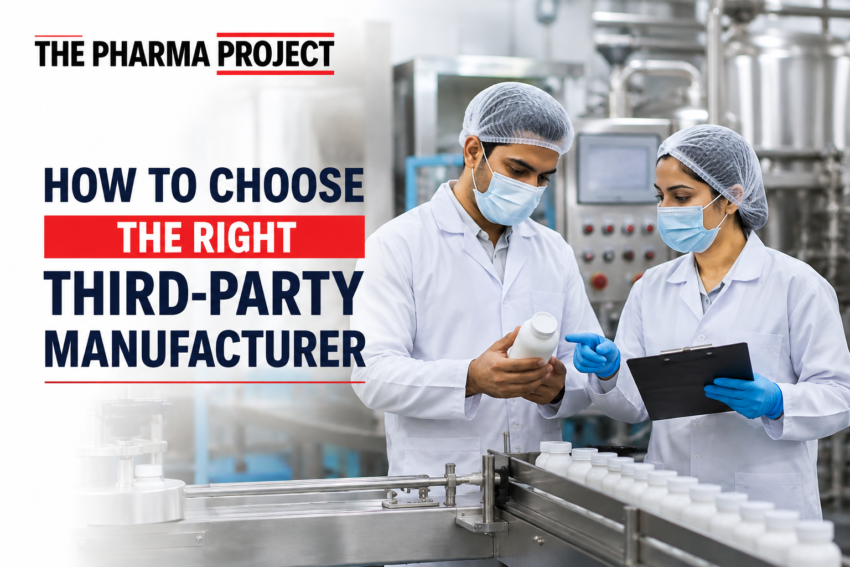
How to Choose the Right Third Party Manufacturer: 12-Point Checklist for 2026
To choose the right third party manufacturer, verify its manufacturing licence, product permissions, GMP status, quality systems, batch capacity, MOQ, testing process, packaging capability, commercial terms, delivery record, complaint handling and contract clauses. Compare at least three factories, inspect the actual unit where possible, approve written specifications and never select a partner only on the lowest quotation. A disciplined 12-point check can prevent delayed launches, rejected batches and damaged brand trust.
Key Takeaways
- Compare at least 3 qualified manufacturers before paying an advance.
- Check the licence address, legal name and approved products against your proposed range.
- A ₹2 cheaper strip can become expensive if rejection, leakage or delay crosses even 2% to 4%.
- Ask for a written lead time, normally 35 to 75 days depending on approvals and packaging.
- Keep a 12-point vendor scorecard and avoid selecting only on MOQ or rate.
India’s pharmaceutical market is estimated at about ₹5,20,000 crore in 2026, according to IBEF. That scale creates thousands of manufacturing options, from large export-oriented plants to smaller units serving regional marketers. But more choice doesn’t automatically mean safer choice.
The dangerous part is that two quotations can look almost identical.
One manufacturer may quote ₹18.70 per strip with complete testing, documented batch release and reliable dispatch. Another may quote ₹17.90, then add carton charges, delay printed foil, change the agreed source and stop answering after the advance. Which one is cheaper now?
If you’re trying to understand how to choose third party manufacturer for tablets, capsules, syrups, nutraceuticals, Ayurvedic products or personal care, you need more than a company profile. You need evidence. Licences, product scope, samples, batch records, written commercials and a realistic complaint process matter far more than a glossy brochure.
This guide gives you a practical 12-point checklist. It is written for PCD franchise owners, D2C founders, distributors and small pharma marketers who are about to spend real money. Use it before you shortlist a plant in Baddi, Solan, Haridwar, Paonta Sahib, Ahmedabad, Sikkim or any other manufacturing cluster.
Why Does Choosing the Right Third Party Manufacturer Matter in 2026?
The right manufacturer protects product quality, launch timelines, working capital and your brand’s reputation.
Third party manufacturing is when a licensed factory produces goods for another company under an agreed product specification, brand name and commercial contract. You handle marketing and distribution. The factory handles manufacturing, quality control, packing and batch release according to the agreed arrangement.
The model saves capital. You don’t need to buy land, install machines, hire production staff or run a full quality-control department. But it also creates dependency. Your launch date depends on someone else’s raw-material planning. Your customer complaints depend on someone else’s batch discipline. Your cash gets locked in someone else’s production schedule.
That is why a ₹1.8 lakh first order deserves proper due diligence.
India’s pharmaceutical market was estimated at ₹4,97,000 crore in 2025 and ₹5,20,000 crore in 2026 by IBEF. The opportunity is large, but competition is unforgiving. Companies such as Dabur, Himalaya, Patanjali, Baidyanath, Zandu and Charak have spent years building product consistency and distribution trust. A new brand cannot afford repeated variation in colour, taste, dissolution, viscosity or packaging.
The pharma third party manufacturing section covers related sourcing topics. If your business depends on monopoly distribution, also understand how PCD pharma franchise works before selecting the production partner.
Which Type of Third Party Manufacturer Do You Actually Need?
You need a manufacturer whose licence, equipment, batch size and commercial model match your product category and expected sales volume.
| Manufacturer Type | Best For | Typical Strength | Likely Limitation |
|---|---|---|---|
| General formulation unit | Tablets, capsules, syrups | Broad catalogue and accessible MOQ | Less specialisation in complex forms |
| Specialised dosage-form unit | MDI, softgel, beta-lactam, sterile products | Dedicated equipment and experience | Higher MOQ and stricter onboarding |
| Nutraceutical manufacturer | Protein, gummies, sachets, supplements | Flavour and food-compliance experience | May not hold drug permissions |
| Ayurvedic manufacturer | Classical and proprietary Ayurvedic products | Herbal sourcing and AYUSH documentation | Different route from allopathic medicines |
| Export-oriented plant | Overseas markets | Documentation and international packaging | Higher commercial threshold |
| Small regional unit | Limited launches | Flexible communication and lower MOQ | Capacity and systems can vary |
Don’t ask a general tablet plant to quote an inhaler and assume it will arrange everything through “contacts.” Specialised products need specialised facilities. This page on an MDI manufacturer in Baddi shows why dosage-form capability must be checked separately.
You should also separate drug, food and Ayurvedic categories. FSSAI licences apply to food and nutraceutical activities. AYUSH permissions cover relevant traditional medicine categories. CDSCO and state drug authorities operate within the drug regulatory system. One certificate doesn’t cover every product.
How to Choose Third Party Manufacturer: The Complete 12-Point Checklist
You should choose a third party manufacturer only after scoring it across legal, technical, quality, commercial and service factors.
1. Verify the Manufacturing Licence
Ask for a clear, current copy of the manufacturing licence. Match the legal name, factory address and licence number with the quotation, invoice and bank details. Check validity and issuing authority.
CDSCO coordinates national drug regulation and state drug-control activities. Use the official CDSCO website for central regulatory information and notifications.
2. Confirm Product Permissions and Dosage Forms
A valid licence isn’t enough. The factory must be authorised and equipped for the exact product category you want.
Request the approved product list. Check whether tablets are plain, coated, dispersible or sustained release. For syrups, clarify sugar-based, sugar-free and suspension capability. If your range includes regulated prescription products, review the site’s Schedule H drugs guide.
3. Check GMP and Quality-System Evidence
GMP evidence matters because final-product testing alone cannot catch every manufacturing risk.
The WHO GMP guidance explains that GMP ensures products are consistently produced and controlled to appropriate quality standards. Ask for the certificate, issuing authority, scope and validity. Don’t accept a logo printed on a company profile as proof.
4. Evaluate Quality Control and Testing
A good manufacturer can clearly explain what it tests, when it tests and who releases the batch.
Ask about raw-material approval, in-process testing, finished-product testing, stability records, microbiological testing where relevant and retention samples. Request a sample certificate of analysis. Also ask a blunt question: what happens when a batch fails?
5. Match Capacity With Your Real Sales Plan
The factory should be large enough to support growth but flexible enough for your realistic starting quantity.
A plant producing 20 lakh tablets per day may not prioritise your 50,000-tablet order. A small plant may welcome it but struggle if you suddenly need five times the quantity. Ask for normal batch size, monthly capacity and current lead time.
6. Understand MOQ at Every Level
MOQ must be checked for the finished product, raw material, foil, bottle, label, carton and shipper.
A manufacturer may offer 500 boxes while the printed foil supplier demands material for 2,000 boxes. Who pays for the balance? Who stores it? What happens if you redesign the brand later? Get these answers in writing.
7. Compare the Complete Landed Cost
The correct comparison is total landed cost, not the basic manufacturing rate.
Include product cost, packing material, printing cylinders, artwork adaptation, testing, freight, GST cash flow, loading, insurance and breakage allowance. A quotation of ₹22.40 per box can become ₹27.85 after additions. Another factory quoting ₹25.10 inclusive may be cheaper.
8. Review Packaging Capability
Packaging quality directly affects stability, compliance and customer confidence.
Inspect foil thickness, bottle grade, cap fit, induction seal, carton GSM, label adhesion, shipper strength and print accuracy. For liquids, test leakage after transport simulation. One weak cap can damage an entire carton.
9. Test Communication and Project Ownership
The manufacturer should give you one responsible contact who tracks artwork, approvals, materials, production and dispatch.
Notice response quality before the order. Does the team answer specific questions or send generic catalogues? From my work with manufacturing clients around Zirakpur and the Baddi belt, buyers often focus on rate first, while experienced marketers test response discipline. They know a ₹3,000 saving means little if artwork approval sits unanswered for 11 days.
10. Check Delivery Performance and Supply Continuity
A reliable manufacturer should provide a realistic timeline and explain possible delays.
Ask for sample approval, packaging, production, testing and dispatch time separately. Standard repeat products may move in 30 to 45 days. New products or printed components can take 60 to 90 days.
11. Examine Complaint, Recall and Replacement Procedures
The contract should explain how quality complaints, shortages, damage, recall and replacement will be handled.
Ask who investigates complaints, what evidence is required, how retained samples are checked and who pays for confirmed defects. A manufacturer that says “complaints never happen” is avoiding the question.
12. Sign a Detailed Manufacturing Agreement
A written agreement should define specifications, commercial terms, confidentiality, brand ownership, responsibilities, timelines and dispute handling.
Include formula ownership where relevant, artwork responsibility, approved vendors, batch rejection, payment milestones, leftover packaging, change control and termination. Don’t rely on chat messages for a six-lakh-rupee order.
How Should You Score and Compare Three Manufacturers?
You should score each shortlisted manufacturer on the same 100-point framework instead of making a decision from memory.
| Evaluation Area | Weight | Manufacturer A | Manufacturer B | Manufacturer C |
|---|---|---|---|---|
| Licence and product permissions | 15 | /15 | /15 | /15 |
| GMP and quality systems | 15 | /15 | /15 | /15 |
| Testing and documentation | 10 | /10 | /10 | /10 |
| Dosage-form experience | 10 | /10 | /10 | /10 |
| MOQ and capacity fit | 10 | /10 | /10 | /10 |
| Total landed cost | 10 | /10 | /10 | /10 |
| Packaging capability | 8 | /8 | /8 | /8 |
| Lead time and dispatch | 8 | /8 | /8 | /8 |
| Communication | 7 | /7 | /7 | /7 |
| Complaint process | 7 | /7 | /7 | /7 |
| Total | 100 | /100 | /100 | /100 |
Set a minimum score. For a standard domestic product, you may decide not to proceed below 72 out of 100. For exports or specialised forms, the threshold should be higher.
And use knockout rules. No valid licence means no deal. No product permission means no deal. Refusal to disclose the actual manufacturing location should also stop the process.
How Should You Compare Cost, MOQ and Payment Terms?
You should compare cost, MOQ and payment terms as one working-capital decision, not as three separate numbers.
| Commercial Item | What to Ask | Common Risk | Better Protection |
|---|---|---|---|
| Basic rate | Is packing included? | Hidden charges | Itemised quotation |
| MOQ | Per SKU, batch or component? | Unused printed material | Separate MOQ sheet |
| Advance | What stage does it cover? | Full payment before proof | Milestone payment |
| Price validity | How long is it valid? | Rate change after artwork | Written validity |
| Freight | Ex-factory or delivered? | Unexpected transport | Destination quote |
| Rejection | Who pays for defects? | No replacement | Contract clause |
| Leftover packing | Who owns and stores it? | Loss after redesign | Inventory statement |
Suppose Manufacturer A quotes ₹86,000 for 1,000 boxes with 50% advance. Manufacturer B quotes ₹91,500 with testing, freight and cartons included. Manufacturer C quotes ₹79,800 but requires 100% advance and charges printed foil separately.
The cheapest line item is not automatically the safest order.
Calculate the money blocked until sale. If a lower MOQ raises unit cost by 8% but saves ₹1.4 lakh in slow-moving inventory, it may be the smarter launch decision.
Which Documents Should You Collect Before Final Approval?
You should collect legal, regulatory, technical, quality and commercial documents before approving production.
- Manufacturing licence and validity details
- Approved product list or permissions
- GMP certificate and scope
- GST registration and PAN
- Factory address and bank details
- Sample certificate of analysis
- Final product specification and composition
- Packaging specification and artwork approval
- Quotation with GST, freight and payment terms
- Manufacturing or supply agreement
- Complaint, replacement and recall process
- Batch documents promised at dispatch
For nutraceutical products, verify applicable permissions through the Food Safety and Standards Authority of India. For Ayurvedic products, review requirements through the Ministry of AYUSH and the relevant state authority.
If you plan exports, the Pharmaceuticals Export Promotion Council of India reported Indian pharma exports of about US$31.11 billion in FY2026. The site’s pharma export resource section can help you build that checklist.
What Should You Inspect During a Factory Visit?
You should inspect material flow, cleanliness, storage, production controls, quality systems, packaging operations and documentation discipline.
Start at the gate. Is visitor entry controlled? Are production zones separated? Does the facility look active or staged only for visitors?
- Raw-material store: Quarantine, approved and rejected materials should be identified.
- Production area: Look for line clearance, status labels and controlled movement.
- Equipment: Ask which machine will produce your batch and its normal capacity.
- Quality-control area: Check instruments, logs and sample handling.
- Packaging hall: Observe coding, reconciliation and printed-material control.
- Finished-goods store: Check batch segregation and dispatch controls.
- Documents: Ask to see blank formats or redacted batch and testing records.
You aren’t conducting a regulatory inspection. But you are deciding whether to trust the unit with your brand and cash.
A factory visit also helps you understand distance and logistics. Baddi, Solan, Paonta Sahib and Haridwar suit many north Indian buyers. Ahmedabad offers a large supplier ecosystem. Sikkim has established pharmaceutical manufacturing, though freight and visit frequency may affect smaller buyers. Zirakpur and Ambala often work as commercial coordination points.
Which Red Flags Should Make You Reject a Manufacturer?
You should reject a manufacturer if it hides the plant, avoids licence verification, changes terms repeatedly or refuses written quality responsibilities.
- Only a marketing office is shown: The actual plant is not disclosed.
- Licence details don’t match: The document belongs to another company or address.
- Every product is “available”: Tablets, injections, cosmetics, gummies and inhalers are all claimed at one unspecified unit.
- Unrealistic delivery: A new printed product is promised in seven days.
- Cash pressure: You are pushed to pay before documents or samples.
- No batch-failure answer: The team cannot explain investigation or replacement.
- Quotation keeps changing: Packing, testing or transport appears later.
- Sample mismatch: The commercial batch can vary without signed specification.
- No agreement: The manufacturer insists the invoice is enough.
Drug content should not be copied from random marketplace listings. For examples of how medicine information is handled separately, see the medicine uses library and drug information resources.
What Is the Best 7-Step Manufacturer Selection Process?
The best selection process moves from a clear brief to screening, evidence review, samples, comparison, factory verification and written approval.
Step 1: Write the Product Brief
List product name, composition, dosage form, pack size, quantity, target market, expected MRP, certifications and launch date.
Step 2: Shortlist Five Companies
Use referrals, trade networks and direct searches. Remove companies that don’t match the dosage form or location.
Step 3: Screen the Documents
Check licence, product permissions, GMP evidence and legal details. Reduce the list to three serious options.
Step 4: Request Samples and Quotations
Ask every company to quote the same specification. Compare samples using the same quality points.
Step 5: Score the Finalists
Use the 100-point table above. Add comments for every score.
Step 6: Visit or Video-Audit the Unit
Visit the top one or two plants. If travel isn’t possible, request a live video walkthrough, not an edited promotional video.
Step 7: Sign, Approve and Start With a Controlled Order
Freeze the specification, artwork, price, timeline and quality responsibilities. Start with a manageable batch unless confirmed demand supports more.
You can get a free manufacturing quote by sharing the product, composition, pack size and expected quantity.
Frequently Asked Questions
What is cosmetic third party manufacturing?
Cosmetic third party manufacturing is a business model where a licensed
manufacturer produces cosmetic products under your brand name. The
manufacturer handles production, quality control and packaging while
you focus on branding, sales and marketing.
What is the minimum MOQ?
Most cosmetic manufacturers in India offer an MOQ between 500 and
3,000 units depending on the product category, packaging and formulation.
Conclusion: Select for Reliability, Not Just Rate
Learning how to choose third party manufacturer is mostly about asking better questions before money changes hands. Three points matter most. Verify the legal and product permissions, compare the complete landed cost, and document quality responsibilities in a written agreement.
Use the 12-point checklist. Score at least three manufacturers. Visit the actual plant where possible. A reliable partner should explain its testing, capacity, packaging, lead time and complaint process without vague answers.
Don’t rush because a salesperson says the production slot will disappear tomorrow. A delayed shortlisting process may cost you a week. A wrong manufacturer can cost you an entire season, blocked capital and distributor trust.
Start with a controlled order. Review the first batch closely. Store a sealed reference sample and track complaints by batch number. Once the manufacturer proves consistency, you can scale with more confidence.
Your brand name goes on the pack. Choose the factory accordingly.
Read our full Disclaimer and Editorial Policy.