
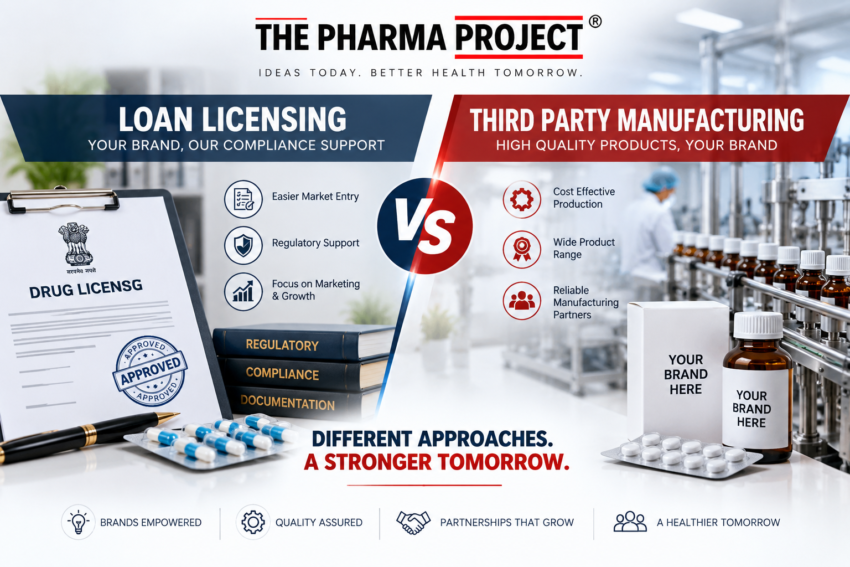
Loan Licensing vs Third Party Manufacturing: Complete 2026 Comparison
Loan licensing vs third party manufacturing mainly differs in who holds the manufacturing licence and how much regulatory control the brand owner takes. A loan-licensee obtains permission to manufacture using another licensed factory’s facility. In third party manufacturing, the factory normally produces under its own licence for the marketer. Loan licensing offers more direct control but adds compliance work; third party manufacturing is usually faster and simpler for new pharma businesses.
- India’s domestic pharmaceutical market was valued at about ₹5.30 lakh crore in FY26, according to IBEF.
- For many non-Schedule C, C(I) and X drugs, a loan licence is issued in Form 25A.
- Applicable Schedule C and C(I) loan licences use Form 28A.
- Third party manufacturing usually starts faster because the marketer does not first need its own loan licence.
- Loan licensing offers more regulatory involvement; third party manufacturing usually offers lower setup overhead.
“Loan licence kara lo, control zyada rahega.”
“Nahi sir, third party manufacturing mein sab easy hai.”
You may hear both lines if you speak to pharma manufacturers around Baddi, Zirakpur, Haridwar or Ahmedabad. The problem is that sales teams often use the terms casually, while the legal and commercial difference is important.
If you’re comparing loan licensing vs third party manufacturing, you’re really deciding how close you want to sit to the manufacturing licence, how much compliance work you can handle and how much operational control you need. A company launching 12 PCD products has a different requirement from a marketer planning one high-volume institutional product.
India’s domestic pharmaceutical market was valued at about ₹5.30 lakh crore in FY26 according to IBEF. That scale has created a deep contract-manufacturing ecosystem across Baddi, Solan, Paonta Sahib, Haridwar, Sikkim, Ahmedabad, Ambala and other clusters.
This guide explains the legal structure, cost, timelines, paperwork, control, risks and best-use cases for both models.
What Exactly Do Loan Licensing and Third Party Manufacturing Mean?
A loan licence lets an applicant manufacture drugs by using the manufacturing facilities of an existing licensed manufacturer, while third party manufacturing usually means the manufacturer produces the product for a marketer under the manufacturer’s own licence.
The Drugs Rules define a loan licence as a licence issued to an applicant who intends to avail the manufacturing facilities owned by a licensee. For many drugs other than those in Schedules C, C(I) and X, the loan licence is issued in Form 25A. For applicable Schedule C and C(I) products, Form 28A is the relevant loan-licence form.
In a third party manufacturing arrangement, your brand may appear as “Marketed by” while the licensed factory appears as “Manufactured by.” The factory controls the licensed manufacturing operation and manufactures your batch under its approved product permissions and quality system.
With a loan licence, your company becomes more directly connected to the manufacturing licence arrangement at that host facility. The State Licensing Authority assesses whether the host unit has adequate equipment, staff, capacity and testing facilities before grant of the loan licence.
For broader context, see The Pharma Project’s third party manufacturing resource section and the guide on how the PCD pharma franchise model works.
What Is the Biggest Difference in Loan Licensing vs Third Party Manufacturing?
The biggest difference is that a loan-licensee holds a specific manufacturing licence linked to another manufacturer’s facility, whereas a third party marketer generally relies on the manufacturer’s existing licence and permissions.
Third party manufacturing says: “You manufacture this approved product for my brand.”
Loan licensing says: “I am licensed to manufacture this approved product using your licensed facility.”
That distinction changes who handles licence applications, product endorsements, inspections, documentation and regulatory correspondence. It can also affect how easily you shift factories later.
Having your brand printed on a product does not mean you hold the manufacturing licence. Likewise, paying for a batch does not make the arrangement a loan licence.
The official CDSCO rules are the reference point for actual forms and conditions.
Loan Licence vs Third Party Manufacturing: Side-by-Side Comparison
Third party manufacturing is generally simpler and faster, while loan licensing gives the applicant greater regulatory involvement and potentially more control over a selected manufacturing relationship.
| Factor | Loan Licensing | Third Party Manufacturing |
|---|---|---|
| Manufacturing licence | Applicant holds loan licence linked to host facility | Manufacturer uses its own licence |
| Regulatory involvement | Higher for brand owner | Lower for marketer |
| Setup speed | Slower because licensing is involved | Usually faster if product permission exists |
| Initial compliance work | Higher | Lower |
| Manufacturing control | Generally higher | Depends on contract and supplier relationship |
| Best fit | Repeat volume and closer manufacturing involvement | PCD, D2C, regional marketers and faster launches |
| Changing factory | May require licensing changes | Commercially easier, though approvals and artwork change |
WHO GMP guidance also treats contract production as a formal quality responsibility. Contract production and analysis should be correctly defined, agreed and controlled, and the contract giver should be able to audit the contract acceptor’s facilities and activities.
Which Model Costs More in 2026?
Loan licensing normally carries more upfront compliance and administrative cost, while third party manufacturing usually has lower setup cost but may offer less direct control.
| Cost Head | Loan Licence | Third Party Manufacturing |
|---|---|---|
| Licence application and documentation | Applicable | Usually not required for marketer as manufacturer |
| Regulatory consultant / compliance support | Often ₹18,500 to ₹85,000+ depending on scope | ₹0 to ₹25,000 for commercial/document support |
| Factory documentation coordination | Higher | Medium |
| Artwork / setup | ₹6,500 to ₹35,000+ | ₹6,500 to ₹35,000+ |
| Batch MOQ | Negotiated with host plant | Negotiated with manufacturer |
| First-production lead time | Potentially several extra weeks | Often 30 to 60 days if approvals exist |
These are planning ranges, not official licence fees. Official fees and procedures depend on the relevant application and State Licensing Authority.
Why accept extra cost? Because control can be valuable at scale. If you are producing the same high-volume product every month, the additional compliance may be justified. If you are testing 15 PCD products with small quantities, it may not be.
From my work around Zirakpur and the Baddi belt, I’ve noticed that newer marketers often ask about loan licensing because it sounds more official. After they map the paperwork and expected volume, many realise that third party manufacturing fits the first 12 to 18 months better. Companies that still choose a loan licence usually have a clearer product plan and repeat volume.
Which Documents and Licences Do You Need?
Loan licensing requires a formal licence application linked to the host manufacturing facility, while third party manufacturing mainly requires you to verify the manufacturer’s licences, product permissions and contractual documents.
For a Loan Licence
- Application in the applicable form under the Drugs Rules
- Host manufacturer’s valid manufacturing licence
- Details of premises, equipment and manufacturing capacity
- Technical staff and testing-facility information where applicable
- List of products proposed under the loan licence
- Consent or manufacturing arrangement with the host unit
- Applicable government fee and State Licensing Authority documents
- Product-specific permissions or endorsements after licence approval
For drugs other than those specified in Schedules C, C(I) and X, Rule 70A provides for Form 25A. For applicable Schedule C and C(I) drugs, Form 28A applies under Rule 76A.
For Third Party Manufacturing
- Manufacturer’s valid drug manufacturing licence
- Approved product list or permission for your composition
- Current GMP / Schedule M evidence
- GST and legal entity documents
- Final composition and product specification
- Artwork approval
- Quotation and payment terms
- Manufacturing or quality agreement
If your range includes prescription medicines, this Schedule H drugs guide is useful. For specialised dosage forms, the page on an MDI manufacturer in Baddi shows why facility capability must be verified product by product.
Which Model Gives You More Control Over Quality and Production?
Loan licensing usually gives you greater formal involvement, but actual quality control still depends on the host factory’s systems, your audits and the written agreement.
A licence does not magically improve a poor plant.
WHO defines GMP as the system that ensures medicinal products are consistently produced and controlled to appropriate quality standards, including responsibilities for contract manufacturing, testing, complaints and product defects.
- Can you audit the facility?
- Who approves raw materials?
- Who releases the finished batch?
- What happens if a batch fails?
- Who owns leftover printed packing material?
- How are complaints investigated?
- Can formula or vendor changes happen without your written approval?
Third party manufacturing can still give you strong control if your agreement is good and your volumes make you an important customer. Loan licensing can still be frustrating if communication is poor.
How Do You Choose Between Loan Licensing and Third Party Manufacturing?
Choose third party manufacturing for speed and lower overhead; choose loan licensing when repeat volume and regulatory control justify the extra compliance.
| Your Situation | Better Starting Option | Why |
|---|---|---|
| New PCD company with 10 to 20 SKUs | Third party manufacturing | Faster range launch and lower compliance load |
| One high-volume product | Loan licence may fit | More direct long-term control can justify setup |
| D2C nutraceutical brand | Third party / private label | Different regulatory framework and speed matters |
| Institutional supply business | Depends on tender and licence requirements | Documentation and site control can be critical |
| Company planning own plant later | Loan licence can be a learning step | Builds manufacturing compliance experience |
| Low working capital | Third party manufacturing | Lower fixed compliance burden |
Don’t decide based on prestige. Decide based on economics and control.
If your annual projected manufacturing value is ₹18 lakh and you are still changing your range every quarter, a loan licence may create more administration than value. If one product alone is doing ₹2.4 crore annually and quality consistency is strategically important, the equation changes.
For exports, use The Pharma Project’s pharma export resources and official Pharmexcil information to build a country-specific checklist.
What Common Mistakes Should You Avoid?
The biggest mistakes are using the two terms interchangeably, assuming licence ownership equals quality, ignoring product permissions and choosing the model before calculating real volume.
1. Calling every outsourced order a loan licence
It isn’t. Check who actually holds the manufacturing licence for your product and under which arrangement.
2. Choosing loan licensing only for image
Customers rarely care which commercial structure you use. They care about product quality, availability and price.
3. Ignoring product permission
A valid manufacturing licence does not automatically cover every composition. Match the exact product and dosage form.
4. Skipping the quality agreement
Whether loan licence or third party, responsibilities for specifications, testing, release, complaints and recall should be written.
5. Underestimating switching cost
Changing factories can mean new artwork, packaging stock, approvals and validation work. Build exit terms into the agreement.
6. Comparing only the first batch
Look at twelve-month economics. Include licence support, consultant cost, staff time, MOQ, freight, rejected packs and inventory.
You can get a free manufacturing quote by sharing your product list, dosage forms and expected annual quantity.
Frequently Asked Questions About Loan Licensing vs Third Party Manufacturing
These answers cover the practical legal and commercial questions pharma entrepreneurs ask before choosing a manufacturing model.
What is the main difference between loan licensing and third party manufacturing?
The main difference is regulatory control and licence structure. Under a loan licence, the applicant obtains a licence to manufacture using another licensed manufacturer’s facility. In ordinary third party manufacturing, the manufacturing unit produces goods for the marketer under its own manufacturing licence and approved permissions. Commercial control, documentation and regulatory responsibility therefore differ between the two models.
What is a loan licence in Indian pharma manufacturing?
The Drugs Rules define a loan licence as a licence issued to an applicant who intends to use manufacturing facilities owned by another licensee. For drugs other than those in Schedules C, C(I) and X, the loan licence is issued in Form 25A. For applicable Schedule C and C(I) drugs, Form 28A is used, subject to the Rules.
Is third party manufacturing the same as a loan licence?
No. The terms are often mixed in sales conversations, but they are not the same regulatory arrangement. A third party manufacturer commonly manufactures under its own licence and approved product permissions for a marketer. A loan-licensee, by contrast, holds its own loan licence linked to the manufacturing premises and approved products under the applicable rules.
Which model gives more control over manufacturing?
Loan licensing generally gives the brand owner more direct regulatory involvement because the loan-licensee is itself licensed to manufacture through the host facility. Third party manufacturing is usually simpler operationally but places more manufacturing-control responsibility with the licensed manufacturer. Actual control also depends on the contract, audit rights and commercial relationship.
Which model is cheaper for a new pharma company?
Third party manufacturing is usually cheaper and faster for a new marketer because you can avoid the additional licensing process, technical documentation and compliance burden associated with holding a loan licence. Loan licensing may make sense once order volume, product strategy and operational capability justify the extra control. Compare total annual cost, not only the first batch.
How long does a loan licence take in India?
There is no single national processing time that applies to every application because the State Licensing Authority, product category, inspection readiness and documentation affect the timeline. For commercial planning, allow several weeks and avoid printing launch material until the licence and approved product scope are clear. Ask the relevant state authority for the current process and fee schedule.
Can I use one loan licence for multiple manufacturers?
A loan licence is tied to the licensed manufacturing premises and approved arrangement, so you should not assume one licence automatically covers unrelated factories. If you want to use another site, confirm the applicable licensing requirement with the relevant State Licensing Authority and update approvals as required before production begins.
Do I still need a manufacturing agreement in third party manufacturing?
Yes. A written manufacturing or supply agreement should define the product specification, batch size, price, payment, packaging, artwork, testing, release, complaints, recall, leftover materials, confidentiality and termination. WHO GMP guidance also stresses that contract production responsibilities should be clearly defined, agreed and controlled to avoid quality misunderstandings.
Which model is better for PCD pharma franchise companies?
For many PCD companies, third party manufacturing is the more practical starting model because it reduces regulatory overhead and lets you source multiple approved products from established units. Loan licensing can suit companies that want deeper control over selected products, repeat large volumes or a closer manufacturing arrangement. The right choice depends on scale and compliance capacity.
Can both loan licensing and third party manufacturing be used for exports?
Both structures can support export-oriented business, but the destination market determines the real requirements. Export registration, dossier, GMP status, site approval, free-sale documents and country-specific labelling may matter more than the commercial label placed on the relationship. Confirm the actual manufacturing site and regulatory responsibilities before committing to an export order.
Conclusion: Choose the Model That Matches Your Scale
Loan licensing and third party manufacturing can both work well, but they solve different problems. Third party manufacturing is usually the easier starting point because you can launch faster, test products and avoid the additional licensing burden. Loan licensing makes more sense when you want closer regulatory involvement, have repeat volumes and are ready to manage the compliance work.
Three points matter most. First off, verify the actual manufacturing site and product permission. Next up, calculate the full twelve-month cost instead of only the first-batch rate. Finally, put quality responsibilities in writing.
India’s pharma manufacturing ecosystem gives you plenty of choice. That is useful only if you understand what you’re signing.
Start with the business model, not the terminology. Once your volume and control needs are clear, the right structure becomes much easier to choose.
Read our full Disclaimer and Editorial Policy.