
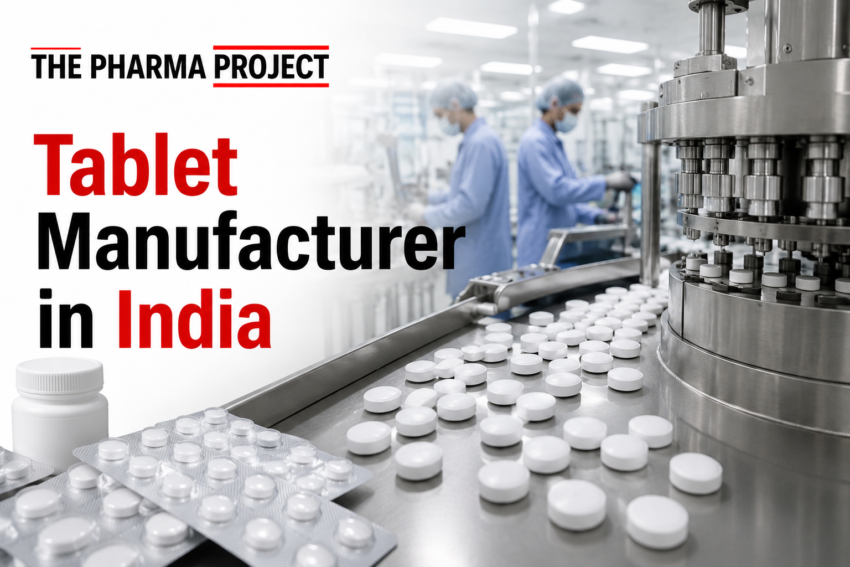
Tablet Manufacturer in India: Cost, MOQ, Process and Verification Guide 2026
A tablet manufacturer in India develops, compresses, coats, tests and packs pharmaceutical or nutraceutical tablets for its own brands and third-party clients. In 2026, practical third-party MOQs generally start around 30,000 to 100,000 tablets per formulation, while commercial pricing depends on ingredients, strength, coating, testing and packaging. Before paying an advance, verify the manufacturing licence, GMP status, approved product permission, testing setup, batch documents and written delivery terms.
Key Takeaways
- Standard third-party orders commonly begin at 30,000 to 100,000 tablets per formulation, although special coatings and slow-moving molecules can require more.
- A basic uncoated tablet may cost roughly ₹0.28 to ₹1.35 per unit, while complex, sustained-release or premium nutraceutical tablets may cross ₹4.80 per unit.
- Allow 35 to 60 days for a first commercial batch because artwork, product permission, raw materials, testing and packaging all take time.
- Ask for at least 8 documents before finalising a unit, including the drug licence, GMP certificate, product permission, COA format and GST details.
- India’s pharmaceutical market is estimated at about ₹5,20,000 crore in 2026, which explains the depth of manufacturing capacity across major pharma clusters.
The Indian pharmaceutical market is estimated at around ₹5,20,000 crore in 2026, according to IBEF’s pharmaceutical industry analysis. That scale has created serious manufacturing depth in Baddi, Solan, Haridwar, Ahmedabad, Sikkim, Paonta Sahib and several other clusters. It has also created noise. Search for a tablet manufacturer in India and you’ll find hundreds of websites using the same claims, the same stock photos and, quite often, the same product list.
What exactly does a tablet manufacturer in India do?
A tablet manufacturer converts an approved formulation into tested, packed and sale-ready tablets under controlled pharmaceutical production conditions.
Tablet manufacturing is the process of dispensing ingredients, blending or granulating them, compressing the blend into tablets, applying coating where required, testing the batch and packing it in an approved format. A third-party manufacturer performs these activities for another company’s brand. Your business owns or markets the brand, while the licensed factory handles production.
A capable unit may also support composition feasibility, product permission coordination, artwork checks, analytical testing and dispatch documents. Confirm the exact scope before paying.
Some plants focus on high-volume general tablets. Others specialise in beta-lactam products, hormonal tablets, effervescent tablets, sustained-release formulations or nutraceutical products. Dedicated facilities and separate production areas matter because cross-contamination controls change by category. For prescription products, you should also understand how scheduled medicines are regulated. Our guide to the Schedule H drugs list gives useful background for marketers entering regulated therapy segments.
Why does choosing a tablet manufacturer in India make business sense in 2026?
India offers a deep supplier base, trained pharmaceutical manpower, broad formulation capability and competitive conversion economics for both domestic and export-focused tablet brands.
IBEF estimates India’s pharmaceutical market at roughly ₹5,20,000 crore in 2026. Pharmexcil also reports that pharma exports reached about US$31.11 billion in FY2026, showing the scale of India’s documented manufacturing base. See Pharmexcil’s industry updates for export context.
From our work with pharmaceutical manufacturing clients around Zirakpur and the Baddi belt, one pattern appears repeatedly: serious buyers ask for product permissions and packing details early, while inexperienced buyers start with “best rate” and discuss compliance after negotiating the price. The first group usually reaches production faster.
Which tablet categories can an Indian manufacturer produce?
Indian plants can produce conventional, coated, chewable, dispersible, sublingual, effervescent, modified-release and nutraceutical tablets, subject to facility capability and product permission.
| Tablet category | Typical use or format | Manufacturing complexity | Practical MOQ signal |
|---|---|---|---|
| Uncoated tablets | Common immediate-release formulations | Low to moderate | 30,000 to 100,000 tablets |
| Film-coated tablets | Taste masking, appearance, protection | Moderate | 50,000 to 100,000 tablets |
| Enteric-coated tablets | Delayed release in the intestine | High | 75,000 to 150,000 tablets |
| Sustained-release tablets | Controlled drug release over time | High | 60,000 to 150,000 tablets |
| Chewable tablets | Antacids, paediatric and nutrition products | Moderate | 50,000 to 100,000 tablets |
| Dispersible tablets | Tablets dispersed in water before use | Moderate to high | 50,000 to 100,000 tablets |
| Effervescent tablets | Fast dissolution in water | High, moisture-sensitive | 100,000 to 300,000 tablets |
| Nutraceutical tablets | Vitamins, minerals and botanical blends | Varies by formula | 30,000 to 100,000 tablets |
Which Indian manufacturing cluster is best for your tablet order?
The best manufacturing cluster is the one that matches your dosage form, required certifications, freight route, order size and speed of coordination.
| Cluster | Common strength | Best suited for | Buyer consideration |
|---|---|---|---|
| Baddi and Solan, Himachal Pradesh | Dense pharma ecosystem and packaging vendors | PCD portfolios, general tablets, multi-product orders | Easy coordination from Chandigarh, Zirakpur and Ambala |
| Paonta Sahib, Himachal Pradesh | Established formulation manufacturing base | General formulations and institutional production | Check logistics and minimum batch acceptance |
| Haridwar, Uttarakhand | Pharma, herbal and consumer-health manufacturing | Mixed pharmaceutical and wellness portfolios | Confirm whether product falls under drug or food rules |
| Ahmedabad and nearby Gujarat clusters | Strong formulation, API and export ecosystem | Technical formulations and larger commercial orders | Freight can affect smaller North India orders |
| Sikkim | Large-scale branded formulation facilities | Established businesses and planned volume | Longer coordination and freight for small buyers |
| Hyderabad and Telangana belt | API access and technical manufacturing depth | Complex formulations and export-oriented sourcing | Audit capability and batch size vary widely |
How much do tablet manufacturing and MOQ cost in India?
Tablet manufacturing cost usually ranges from about ₹0.28 to ₹4.80 per tablet, while first-order MOQs commonly fall between 30,000 and 150,000 tablets per formulation.
These are planning ranges, not a universal rate card. Composition, tablet weight, coating, testing, foil, carton quality and batch size change the final quote.
| Cost component | Indicative 2026 range | What changes the price |
|---|---|---|
| Basic uncoated tablet | ₹0.28 to ₹1.35 per tablet | API cost, tablet weight and batch size |
| Film-coated tablet | ₹0.55 to ₹2.25 per tablet | Coating material, colour and process time |
| Modified-release tablet | ₹1.10 to ₹4.80 per tablet | Polymer system, dissolution testing and development work |
| Alu-PVC blister | ₹0.22 to ₹0.78 per 10-tablet strip | Foil gauge, printing, cavity size and volume |
| Alu-Alu blister | ₹0.95 to ₹2.65 per 10-tablet strip | Forming foil, cavity design and wastage |
| Printed carton | ₹1.65 to ₹6.40 per carton | Board GSM, lamination, colours and quantity |
| Artwork and cylinder setup | ₹3,500 to ₹18,500 per SKU | Number of colours, foil process and vendor policy |
| Product testing or special analysis | ₹4,500 to ₹32,000 per requirement | Method, lab, stability or microbiological testing |
For 50,000 tablets at a landed manufacturing and packing cost of ₹1.62 each, the batch value is about ₹81,000 before GST and freight. Design setup or premium foil can push the first outlay beyond ₹1,08,000.
Compare composition, tablet weight, strip type, foil, cartons, testing, freight, GST and payment terms line by line.
Send your composition, pack size and quantity. We reply within 24 hours.
How do you verify a tablet manufacturing company before payment?
You should verify the factory’s legal permissions, dosage-form capability, quality records, commercial terms and physical manufacturing setup before releasing a substantial advance.
- Check the manufacturing licence: Match the legal company name, factory address, dosage form and validity details.
- Review GMP evidence: Ask for the current GMP certificate and confirm the issuing authority. WHO explains that GMP covers production and quality-control measures, including documented processes, suitable premises and trained personnel.
- Verify product permission: The unit should have permission for your exact or legally acceptable composition before commercial manufacture.
- Inspect testing capability: Ask whether chemical, physical, microbiological and stability tests are performed in-house or through an approved external laboratory.
- Request a sample COA: A Certificate of Analysis should show relevant specifications, test results, batch details and approval status.
- See actual product samples: Check embossing, edge quality, coating uniformity, blister sealing, print sharpness and carton strength.
- Ask for a plant video or visit: Stock photographs prove nothing. A factory visit is better, especially for a first order above ₹2,50,000.
- Confirm written timelines: Separate artwork approval time, raw-material lead time, production time, testing and dispatch.
- Check GST and bank details: Pay only into an account matching the contracting entity, unless the relationship is clearly documented.
- Read the agreement: Include confidentiality, brand ownership, rejected-goods handling, payment milestones and dispute terms.
The Central Drugs Standard Control Organisation coordinates national drug standards and state regulatory activity. A logo on a website is not proof that a plant can manufacture your exact product.
Score suppliers on compliance, product capability, quality documents, communication, commercial terms and logistics. This prevents a decision based only on the fastest salesperson.
What is the seven-step tablet manufacturing process?
The commercial process moves through product finalisation, compliance checks, costing, artwork, material procurement, production, testing and documented dispatch.
- Finalise the product and market position.
Decide the composition, strength, dosage form, pack size, target MRP and channel. A PCD product, hospital tender product and D2C supplement have different price and packaging needs. - Confirm regulatory classification and permission.
Determine whether the product falls under pharmaceutical drug rules, nutraceutical regulations or another applicable category. Food-category products may require reference to the FSSAI regulatory framework, while drug products follow the applicable Drugs and Cosmetics rules and permissions. - Approve the commercial quotation.
Freeze the quantity, unit rate, packing specification, taxes, freight, payment milestones and delivery conditions. Get a signed proforma invoice. - Prepare and approve artwork.
Your carton and foil text must match the approved composition, claims and legal declarations. One spelling correction after cylinder creation can cost ₹6,500 or more. - Procure and test raw materials.
The unit sources APIs, excipients and packaging materials against approved specifications. Incoming materials should be quarantined, sampled and released by quality control. - Manufacture and perform in-process checks.
Depending on the formulation, the process may include sifting, dry or wet granulation, drying, milling, lubrication, compression and coating. Operators monitor weight variation, hardness, thickness and friability during production. - Complete finished-product testing and dispatch.
Quality teams evaluate the batch against approved specifications. After release, the manufacturer packs, invoices and dispatches the goods with batch records such as the COA and transport documents.
Which documents and licences do you need for third-party tablet manufacturing?
You need business documents for your marketing entity, valid manufacturing permissions from the factory, product-specific approval and a written manufacturing arrangement.
| Document | Usually provided by | Why it matters |
|---|---|---|
| GST registration | Brand owner and manufacturer | Commercial invoicing and tax compliance |
| Company constitution documents | Brand owner | Confirms legal entity and authorised signatory |
| Trademark application or registration | Brand owner | Supports brand ownership and reduces naming disputes |
| Drug manufacturing licence | Manufacturer | Shows legal authority for the relevant dosage form |
| GMP certificate | Manufacturer | Shows quality-system status under the applicable framework |
| Product permission | Manufacturer or regulatory consultant | Confirms approval for the formulation |
| Manufacturing agreement | Both parties | Defines responsibilities, quality, payment and brand terms |
| Artwork approval sheet | Both parties | Creates a final written record before printing |
| Certificate of Analysis | Manufacturer’s quality unit | Records batch test results against specifications |
Export orders need additional work. Market registration, Free Sale Certificate requirements, Certificate of Pharmaceutical Product, country-specific artwork, legalisation and shipping documents can extend the timeline. Pharmexcil is the relevant Indian export promotion body for pharmaceuticals, and our pharmaceutical export resources cover the commercial side in more detail.
Which tablet quality checks should you insist on?
You should insist on documented checks for identity, assay, uniformity, disintegration or dissolution, physical strength, impurities and packaging integrity as applicable to the product.
WHO describes GMP as a system for consistent production and quality control. Final testing alone is not enough because quality also depends on materials, premises, equipment, people, processes and records.
- Hardness: The tablet should survive handling without becoming too hard to disintegrate properly.
- Friability: This evaluates chipping or powder loss under controlled mechanical stress.
- Disintegration: The test checks whether the tablet breaks down within the specified time.
- Dissolution: Especially important for modified-release and many pharmaceutical formulations, it checks drug release under defined conditions.
- Assay and content uniformity: These verify the amount and distribution of the active ingredient.
- Related substances or impurities: Product-specific methods help evaluate degradation or unwanted chemical components.
- Strip or blister integrity: Poor sealing can damage a good tablet through moisture or contamination.
Which six mistakes make tablet manufacturing more expensive?
The most expensive mistakes are vague specifications, premature printing, unrealistic timelines, poor document verification, weak payment terms and ordering too many SKUs at once.
1. Asking only for the lowest rate
A low quote may exclude coating, outer boxes, testing, freight or printed foil. Request a line-by-line quotation and compare identical pack specifications.
2. Launching 20 products in the first batch
More SKUs create more artwork, cylinders, inventory and slow-moving stock. Start with 5 to 8 products that fit one doctor segment or customer need. Expand after you see repeat demand.
3. Approving artwork on WhatsApp without a final PDF
Phone screens hide small errors. Approve a dated PDF that shows foil, carton and label text. Check composition, licence numbers, batch fields, storage conditions, MRP space and spelling.
4. Promising stock before the batch is released
Your manufacturer may finish compression, but QC release and packaging can still take several days. Sell after you have a credible dispatch date, not after someone says “production mein lag gaya hai.”
5. Paying 100% without milestones
Some orders genuinely require a large advance for raw materials and packaging. Even then, define what triggers the next payment. Link payments to artwork approval, material readiness, production or dispatch.
6. Ignoring the second batch
Share your formulation and target pack. Get practical sourcing support within 24 hours.
Frequently Asked Questions About Tablet Manufacturers in India
What is the minimum order quantity for tablet manufacturing in India?
The practical MOQ usually starts around 30,000 to 100,000 tablets per formulation. Film-coated, sustained-release, effervescent or low-dose products may require a higher batch size. The exact quantity depends on equipment capacity, granulation size, packaging material minimums and the cost of testing each batch.
How much does third-party tablet manufacturing cost?
Basic tablets may cost around ₹0.28 to ₹1.35 per unit before GST and freight. Coated, modified-release or expensive-ingredient tablets can range from ₹1.10 to above ₹4.80 each. Packaging can add ₹0.22 to ₹2.65 per strip, depending on Alu-PVC, Alu-Alu and print specifications.
How long does a first tablet manufacturing order take?
A first order generally takes 35 to 60 days after commercial and artwork approval. Product permission, special raw materials, printed foil, stability requirements or complex testing may extend the schedule. Repeat batches can be faster when materials, artwork and regulatory approvals are already available.
How can I check whether a tablet manufacturer is genuine?
Verify the legal company name, factory address, drug manufacturing licence, GMP certificate, product permission, GST registration and bank account. Ask for a live plant video or visit, recent product samples, a sample COA and written quotation. Never rely only on a website, brochure or marketplace profile.
Do I need my own manufacturing licence for third-party manufacturing?
Your licensed third-party factory handles production under its manufacturing permissions, but your own business may need wholesale drug licensing, GST registration and other approvals depending on how and where you sell. Requirements differ by product category and state, so confirm the correct structure before commercial launch.
Can a manufacturer develop a new tablet formulation for my brand?
Some manufacturers have formulation and development teams, while others only manufacture already-approved compositions. New formulations may require feasibility work, analytical method development, stability studies and regulatory approval. Ask for a written development scope, ownership terms, estimated cost and timeline before sharing commercially sensitive details.
What is the difference between Alu-PVC and Alu-Alu tablet packing?
Alu-PVC blister packing uses a clear or opaque plastic cavity sealed with aluminium foil and is usually more economical. Alu-Alu uses aluminium on both sides and offers stronger protection from moisture, light and oxygen. Your formulation’s stability, market positioning and target price should decide the format.
Can I manufacture nutraceutical tablets at a pharma tablet factory?
Only when the facility has the appropriate category approvals, systems and product permissions for the intended product. Nutraceutical tablets may fall under FSSAI rules rather than drug rules. Claims, ingredients, daily usage levels and labels must match the applicable framework, so don’t treat pharma and food licences as interchangeable.
Which location is best for a tablet manufacturer in India?
Baddi and Solan suit many North Indian PCD and general-tablet buyers because the supplier ecosystem is dense. Ahmedabad and Hyderabad offer strong technical depth, while Haridwar supports pharmaceutical and wellness categories. The best location depends on product capability, audit status, MOQ, freight and your ability to coordinate.
What should a tablet manufacturing agreement include?
The agreement should cover the approved composition, specifications, batch size, price, payment schedule, delivery timeline, brand ownership, confidentiality, quality responsibilities, rejected-batch handling, artwork approval, change control and dispute terms. It should also clarify who pays for testing, cylinders, freight, product permission and unused packaging material.
Conclusion: Select for Repeatability, Not Just Rate
A good decision rests on three things: legal authority for the product, repeatable quality and commercial terms that fit your cash flow.
Start with a focused portfolio, compare identical specifications and verify permissions, testing and timelines before paying a large advance.
The cheapest quotation can become the most expensive batch. Choose a tablet manufacturer in India that answers technical questions clearly, documents every approval and treats your second order as seriously as the first. For a structured supplier discussion, you can get a free manufacturing quote from The Pharma Project.
Read our full Disclaimer and Editorial Policy.