
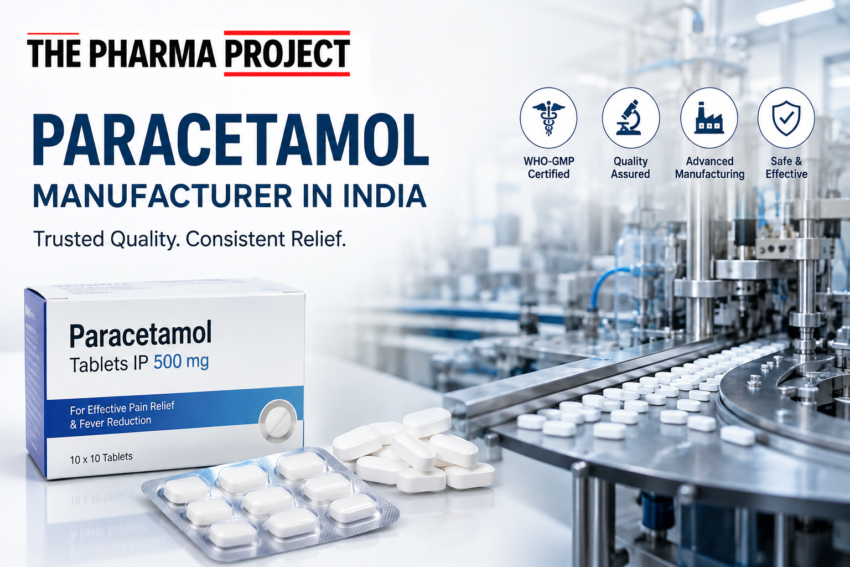
Paracetamol Manufacturer in India: 10 Companies and 2026 Buyer’s Guide
A paracetamol manufacturer in India may produce paracetamol API, finished tablets, capsules, syrups, suspensions or combinations for domestic and export buyers. Established sourcing options include Farmson, Granules India, Sri Krishna Pharmaceuticals, Meghmani and several WHO-GMP formulation units. Before ordering, confirm the exact plant, dosage form, manufacturing licence, approved composition, batch size, testing documents, packaging specification and destination-market compliance.
- Paracetamol tablets are commonly manufactured in 325 mg, 500 mg and 650 mg strengths, subject to approved product permissions.
- Private-label tablet MOQs often begin near 50,000 to 100,000 tablets per strength and pack configuration.
- A basic 10-tablet strip may cost roughly ₹3.10 to ₹8.40 before GST, freight and special packaging, depending on the formula and volume.
- Routine production generally takes 25 to 45 days after artwork, commercial and regulatory approvals.
- Buyers should verify at least 12 plant, licence and quality documents before placing a large order.
Paracetamol looks simple. Buyers still make careless decisions.
India produces huge volumes of generic medicines, and a search for a paracetamol manufacturer in India brings up API plants, tablet factories, PCD marketers, exporters and trading companies. Many will quote within an hour. Far fewer will first ask whether you need paracetamol IP or BP, 500 mg or 650 mg tablets, a paediatric suspension, an export dossier or domestic private-label stock.
India remained the world’s third-largest pharmaceutical producer by volume in 2026, while its domestic pharmaceutical market reached about ₹5.30 lakh crore in FY26, according to IBEF. That scale gives buyers real choice. It also makes verification essential because the company sending a quotation may not own the plant printed under “Manufactured by.”
This guide compares paracetamol API and finished-dosage manufacturers, MOQs, cost drivers, regulatory documents and production stages.
What does paracetamol manufacturing include?
Paracetamol manufacturing includes production of the active pharmaceutical ingredient or conversion of approved API into finished dosage forms such as tablets and oral liquids.
Paracetamol API manufacturing is the controlled chemical production, purification, drying, milling, testing and packing of the active ingredient. Paracetamol is also called acetaminophen in some markets.
Finished-dosage manufacturing is when an authorised formulation plant blends the API with approved excipients and converts it into tablets, capsules, suspensions, syrups or another permitted form. The plant then tests, packs and releases the batch.
Third-party manufacturing is when a licensed factory produces the finished medicine for another company. The buyer’s brand appears on the pack, while the actual factory is disclosed under “Manufactured by.”
These are separate capabilities. An API producer may sell bulk powder but manufacture no tablets. A Baddi formulation unit may produce tablets while buying API from another approved plant.
Businesses researching contract production can explore The Pharma Project’s pharma third-party manufacturing guides. For upstream ingredient sourcing, use the pharma API resource section.
Why do buyers choose a paracetamol manufacturer in India in 2026?
Buyers choose India because it combines large generic-production capacity, experienced formulation clusters, broad packaging support and established pharmaceutical export channels.
The IBEF pharmaceutical industry report states that India was the third-largest pharmaceutical producer by volume in 2026. Its domestic market was valued near ₹5.30 lakh crore in FY26. Scale like this supports everything from API synthesis and excipients to printing, testing, logistics and regulatory services.
India also has geographic depth. Gujarat and Hyderabad support major API operations, while Baddi, Paonta Sahib, Haridwar and Sikkim are known for finished-dose manufacturing.
India’s drugs and pharmaceutical exports reached US$30.46 billion in FY2024-25, according to Pharmexcil’s 2026 trade communication. That export experience can help buyers who need country-specific documentation, but export capability must be confirmed for the exact site and product.
From Vivek’s work with pharma businesses across the Zirakpur and Baddi belt, one buying error appears repeatedly: a customer asks for the lowest paracetamol rate without freezing the strength, strip material or carton quantity. Until those three items match, two quotations aren’t comparable.
Which paracetamol manufacturers in India should you evaluate?
You should evaluate manufacturers whose public portfolio and plant capability match either paracetamol API production or your required finished dosage form.
This is a screening list, not a ranking. A company may manufacture API, finished formulations or both through different sites. Always confirm present availability and regulatory scope directly.
| Company or sourcing option | Commonly associated capability | What you should confirm |
|---|---|---|
| Farmson Pharmaceutical Gujarat | Large-scale paracetamol API production | Grade, plant, standard pack, annual quantity and regulatory documents |
| Granules India | Paracetamol API and pharmaceutical manufacturing | External supply availability, particle size and target-market support |
| Sri Krishna Pharmaceuticals | Paracetamol API and formulation-related capabilities | Exact site, specification, sample and commercial batch scale |
| Meghmani LLP | Paracetamol API manufacturing | Current licence, written confirmation, grade and lead time |
| Para Products | Paracetamol API | Plant status, certificate validity and market documentation |
| WHO-GMP tablet plant in Baddi | Tablets and permitted combinations | Product permission, batch size, API source and packing line |
| Formulation unit in Haridwar | Tablets, oral liquids and private-label packing | Dosage capability, current approvals and quality agreement |
| Export-focused plant in Ahmedabad | Finished formulations and export documentation | Destination registrations, stability zone and dossier ownership |
| PCD or marketing company | Small-order coordination and product range support | Actual manufacturer named on the label and invoice chain |
| Authorised API distributor | Lower quantities and stock-based delivery | Original manufacturer, batch traceability and storage conditions |
Ask each supplier one direct question: “Which company name, site address and licence number will appear under Manufactured by?” A marketer can still be useful, but you need transparent traceability.
New distributors may also find this explanation of how a PCD pharma franchise works useful before deciding whether to manufacture or buy an established brand.
Which paracetamol products can Indian manufacturers supply?
Indian manufacturers commonly supply paracetamol API, immediate-release tablets, dispersible tablets, paediatric oral liquids and approved combination products.
| Product | Common commercial presentation | Critical buying check |
|---|---|---|
| Paracetamol API | IP, BP, USP or customer specification in lined drums | Assay, impurities, particle size, site and retest period |
| Paracetamol 500 mg tablet | 10-tablet blister or strip, bulk pack | Tablet weight, coating, pack material and dissolution |
| Paracetamol 650 mg tablet | 10 or 15 tablets per strip | Product permission, score line and market positioning |
| Paracetamol 325 mg tablet | Single ingredient or approved combination | Composition, claims and combination status |
| Paediatric suspension | 60 ml or 100 ml bottle with measuring device | Strength per 5 ml, flavour, sedimentation and dosing device |
| Oral drops | 15 ml or 30 ml bottle | Concentration, calibrated dropper and paediatric label review |
| Dispersible tablet | Blister or strip pack | Dispersion time, taste and moisture protection |
| Approved fixed-dose combination | Tablets, capsules or oral liquid | Current legal status and exact product permission |
Combination products need extra care. Don’t assume that every familiar paracetamol combination remains permitted. The CDSCO fixed-dose combination page publishes prohibited and restricted FDC notices. Check the current legal position before approving artwork or buying packaging.
What MOQ and manufacturing cost should you expect?
You should expect finished-tablet MOQs near 50,000 to 300,000 tablets and API commercial quantities from about 25 kg, although the exact minimum depends on the plant and specification.
These are practical 2026 planning ranges, not government-fixed prices. Paracetamol is a price-sensitive product. A difference of a few paise per tablet matters at scale, but packaging, testing and credit terms can matter more on a small order.
| Requirement | Indicative 2026 range | Main cost driver |
|---|---|---|
| Paracetamol API evaluation sample | 100 g to 1 kg | Grade, documentation and courier handling |
| Paracetamol API commercial MOQ | 25 kg to 500 kg | Plant pack size, annual volume and pharmacopoeia |
| 500 mg tablet MOQ | 50,000 to 200,000 tablets | Batch size, tooling and packaging configuration |
| 650 mg tablet MOQ | 100,000 to 300,000 tablets | Product approval, tablet weight and demand forecast |
| 10-tablet strip, finished | ₹3.10 to ₹8.40 | Tablet specification, foil, volume and testing |
| 100 ml suspension bottle | ₹18.50 to ₹43.80 | Formula, bottle, cap, carton and measuring device |
| Artwork and printing setup | ₹2,800 to ₹12,500 per SKU | Plate, cylinder, print process and quantity |
| Finished-product testing | ₹4,500 to ₹19,500 per SKU | Test scope, stability and external laboratory |
Ask every supplier to state tablet quantity, strip count, strips per carton, foil type, outer-box quantity, testing, freight, GST and breakage policy. One quotation may include the mono carton while another doesn’t.
Send the strength, pack size and quantity. We reply within 24 hours.
How can you verify a paracetamol manufacturer in India?
You can verify a paracetamol manufacturer by matching its legal identity, plant address, manufacturing licence, product permission, quality records and commercial documents.
- ☐ Obtain the legal entity name, GSTIN and registered address.
- ☐ Record the actual manufacturing site, not only the marketing office.
- ☐ Review the current drug manufacturing licence.
- ☐ Confirm product permission for the exact strength and dosage form.
- ☐ Request current GMP or WHO-GMP evidence being claimed.
- ☐ Check a recent Certificate of Analysis from the proposed facility.
- ☐ Ask for the approved API source and its incoming-test controls.
- ☐ Review dissolution, assay, related substances and uniformity results.
- ☐ Confirm batch size, line capacity and normal production lead time.
- ☐ Inspect artwork control, coding, reconciliation and packing records.
- ☐ Visit the facility or arrange a live video walkthrough.
- ☐ Execute manufacturing and quality agreements before routine supply.
CDSCO is India’s national drug regulatory authority, while state regulators perform important licensing and enforcement functions under the Drugs and Cosmetics framework. Verify records with the relevant authority instead of treating a certificate shared on WhatsApp as final proof.
For EU API exports, CDSCO publishes plant and substance-specific written confirmations. A confirmation for one site doesn’t automatically cover every unit or product.
Which licences and documents do you need?
You need an appropriate drug licence, exact product permission, approved artwork and written quality and manufacturing records before commercial paracetamol production.
Documents normally requested from the marketing company
- Company identity: Legal name, address, PAN and authorised contact.
- GST registration: Required for normal commercial invoicing.
- Wholesale drug licence: Confirm the licence applicable to your selling and distribution activity.
- Trademark proof: Application or registration supporting brand use.
- Final composition approval: Strength, dosage form and pharmacopoeial standard.
- Artwork approval: Signed label, foil, carton and coding details.
- Purchase order: Quantity, rate, tax, freight and payment terms.
- Manufacturing agreement: Responsibilities, formula, quality and confidentiality.
Documents to collect from the manufacturer
- Drug manufacturing licence and exact product permission
- GMP or WHO-GMP certificate, where claimed
- Finished-product Certificate of Analysis
- API Certificate of Analysis and approved-vendor traceability
- Batch manufacturing and packing records
- Stability data supporting shelf life and pack
- Analytical methods and specification
- Recall, complaint and pharmacovigilance process as applicable
- Tax invoice, packing list and transport documents
- Export certificates or dossier support where required
The WHO health-product standards programme explains the broader importance of manufacturing quality and regulatory systems. Don’t confuse a website phrase such as “WHO standard” with a current, site-specific certificate.
FSSAI or AYUSH paperwork doesn’t replace the required drug-manufacturing approvals.
How does third-party paracetamol manufacturing work?
Third-party paracetamol manufacturing normally moves through seven stages, from product selection and document review to production, testing and dispatch.
- Define the product. State 500 mg or 650 mg, tablet or liquid, pack size, market, expected quantity and target landed rate.
- Shortlist three to five factories. Compare the exact dosage line and product permission, not the size of the entire catalogue.
- Review licences and samples. Match the manufacturer, site, strength, composition and quality documents.
- Freeze the commercial specification. Confirm tablet appearance, strip material, carton, master box, batch size, testing and freight.
- Approve compliant artwork. Review composition, warnings, schedule statements where applicable, manufacturer details, batch coding and statutory declarations.
- Place a written purchase order. Record advance, balance, tax, delivery date, rejection process and ownership of printed packaging.
- Manufacture, test and dispatch. Routine batches often need 25 to 45 days after all approvals, although printed foil or special material can extend the schedule.
For a comparison with a technically specialised dosage form, read the guide to MDI manufacturing in Baddi. The principle is the same: verify actual line capability rather than trusting a long product list.
Which paracetamol sourcing mistakes cost buyers the most?
The costliest errors are comparing incomplete quotations, ignoring product permissions and buying printed packaging before approvals are final.
1. Comparing price per strip without comparing the strip
Ten tablets in basic foil aren’t commercially identical to a higher-barrier blister with a mono carton. Write the pack specification first.
2. Assuming the marketer owns a factory
A Zirakpur office may coordinate production in Baddi or Haridwar. That can be legitimate. Still, your agreement and label must identify the responsible manufacturing unit.
3. Skipping the exact product permission
A general tablet licence isn’t proof that the facility can make every strength or combination you request.
4. Printing aggressive claims
Marketing copy doesn’t override approved indications, label rules or product status. Review claims before printing 100,000 cartons.
5. Building margin from MRP
If the MRP is ₹35 but the channel accepts a net sale value of ₹13.80, calculate the business around ₹13.80. Distributor margin, retailer margin, schemes, freight and expiry returns all matter.
6. Launching too many SKUs
Do you need 500 mg tablets, 650 mg tablets, suspension, drops and four combinations on day one? Test demand with a focused range before locking cash into stock.
Monitor regulatory and market developments through The Pharma Project’s pharma news section. For consumer-search context around prescription categories, see the Schedule H drugs list and explanation.
Share the strength, dosage form and target quantity for a practical discussion.
Frequently Asked Questions
Who is the best paracetamol manufacturer in India?
The best paracetamol manufacturer in India depends on whether you need API, tablets, oral liquid, domestic private label or export supply. Farmson, Granules India, Sri Krishna Pharmaceuticals and Meghmani are commonly evaluated for API. Finished-dose buyers should verify the exact plant, product permission, GMP status, MOQ and pack capability.
What is the MOQ for paracetamol tablets in India?
A practical private-label MOQ often starts around 50,000 to 100,000 tablets per strength and pack. Some plants require 200,000 to 300,000 tablets because of batch size or printing economics. Confirm whether MOQ applies to tablets, strips, cartons, each artwork or the complete purchase order.
How much does paracetamol 500 mg third-party manufacturing cost?
A basic strip of 10 paracetamol 500 mg tablets may cost approximately ₹3.10 to ₹8.40 before GST and freight in 2026. The final rate depends on tablet specification, order size, foil, carton, testing, payment terms and API price. Request a written, component-level quotation before comparing suppliers.
Can I launch paracetamol under my own brand?
Yes, a licensed third-party facility can manufacture paracetamol under your brand when the legal and regulatory requirements are met. Your company normally needs suitable business and drug-sale documentation. The label must correctly identify the manufacturer and marketer, while the product strength and composition must match the facility’s permission.
Which licence is required to manufacture paracetamol?
The factory needs an applicable drug manufacturing licence and permission for the exact paracetamol dosage form, strength or combination. Requirements vary with product and activity. Marketing and distribution businesses may need wholesale or other drug licences. Verify the current requirements with the competent central and state drug authorities.
How long does paracetamol manufacturing take?
A standard repeat batch may take roughly 25 to 35 days after commercial and artwork approval. A new brand or special pack can need 35 to 55 days because of printed foil, carton development, sample review and testing. Ask for a written production schedule tied to the final artwork-approval date.
Can Indian manufacturers export paracetamol?
Yes, Indian companies export paracetamol API and finished formulations, subject to destination-country registration and documentation. Buyers may need pharmacopoeial compliance, stability data, a dossier, CoA, GMP evidence, written confirmation, certificate of pharmaceutical product or other market-specific records. Confirm export experience for the exact product and country.
What is the difference between paracetamol API and paracetamol tablets?
Paracetamol API is the active ingredient supplied as tested bulk material, commonly in lined drums. A paracetamol tablet is a finished medicine containing the API plus excipients in an approved dose. API and tablet production require different facilities, processes, specifications, licences, batch sizes and commercial evaluations.
Should I buy directly from a factory or a marketing company?
Direct factory buying can suit larger, repeat orders and gives clearer technical access. A transparent marketing company may offer smaller MOQs, design coordination and a wider portfolio. Either model can work. You should know the actual manufacturer, match all licences and documents, and define responsibility in writing.
Which documents should accompany a paracetamol batch?
A commercial batch should have a tax invoice, packing details and finished-product Certificate of Analysis, with batch number, manufacturing date and expiry or retest information as applicable. Your vendor file should also retain the licence, product permission, GMP evidence, approved artwork, specifications, purchase order and quality agreement.
How should you select the right paracetamol manufacturing partner?
Select a paracetamol partner by verifying the plant, product permission and complete commercial specification before negotiating the final price.
Keep three points clear. One, API production and finished-tablet manufacturing are different businesses. Two, compare rates only after strength, tablet count, foil, carton and testing match. Three, verify the actual unit named on the label rather than relying on a catalogue or sales office.
India offers deep paracetamol capability across Gujarat, Telangana, Baddi, Haridwar, Ahmedabad and other clusters. That gives you options, but it doesn’t remove the need for due diligence.
Start with one or two products. Review samples and documents. Put the production date, packaging ownership and rejection process in writing. If you’re comparing a paracetamol manufacturer in India, share the dosage form, strength, quantity and selling market to get a free manufacturing quote.
Read our full Disclaimer and Editorial Policy.