
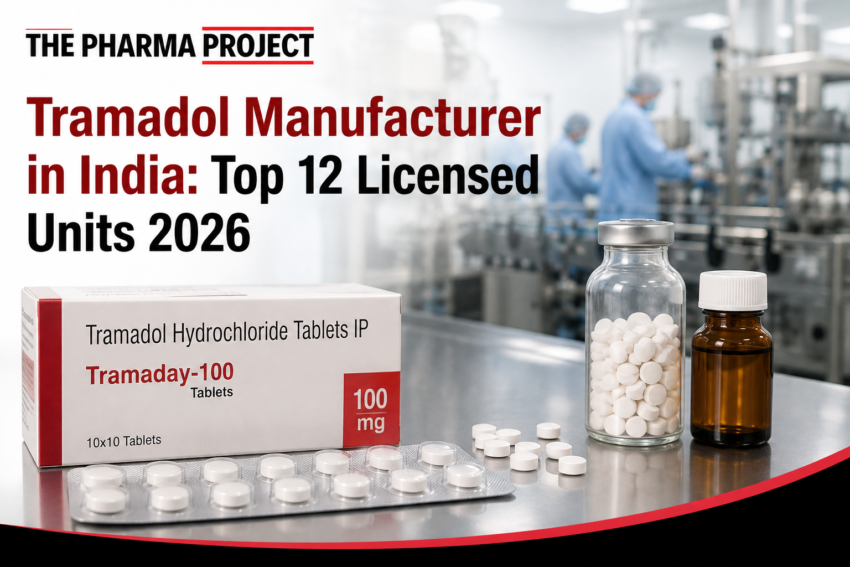
Tramadol Manufacturer in India: 2026 Guide to Licensed Units, NDPS Rules and Real Costs
Quick Answer: A tramadol manufacturer in India is a CDSCO-licensed pharmaceutical unit authorised to produce tramadol hydrochloride formulations under the NDPS Act 1985. Since April 2018, tramadol requires dual licensing: a standard drug manufacturing licence plus a Narcotics Commissioner permit with an annual quota. Around 40 verified units hold active tramadol rights in 2026, mostly in Baddi, Sikkim and Ahmedabad. Third-party pricing ranges from ₹0.85 to ₹1.65 per tablet at MOQs starting at 1,00,000 units.
Key Takeaways
- Tramadol was notified under the NDPS Act in April 2018, making dual licensing (drug licence + narcotics permit) mandatory for every batch produced in India.
- Third-party MOQ starts at 1,00,000 tablets for tramadol 50mg and can go up to 5,00,000 units for injectables.
- 2026 per-tablet cost: ₹0.85 to ₹1.65 for tramadol 50mg; ₹1.10 to ₹2.20 for tramadol + paracetamol combinations.
- Only around 40 units across India hold active NDPS tramadol quotas, mostly clustered in Baddi (HP), Sikkim, and Ahmedabad.
- Timeline from first enquiry to dispatch of first batch: 60 to 90 days, factoring in narcotics quota release and buyer’s own Schedule H1 wholesale licence.
Introduction
India makes nearly one in every three tablets of generic tramadol consumed globally, but fewer than 45 manufacturers can legally produce it inside the country. Surprised? Most buyers are. Since April 2018, tramadol has sat under both Schedule H1 and the NDPS Act, which means finding a genuine tramadol manufacturer in India in 2026 is nothing like sourcing a routine antibiotic or a multivitamin.
You’ve probably already run into the mess. A supplier promises fast dispatch, then goes quiet the moment you ask for their NDPS licence copy. Or the per-tablet quote sounds unreal, and later you realise the plan is to divert someone else’s quota. This happens more often than the industry likes to admit.
This guide is written for pharma entrepreneurs, PCD franchise owners, small D2C founders, and existing marketing companies who need actual numbers. You’ll get 2026 pricing, minimum order quantities, a licensing checklist, and the exact documents your third-party unit must show you before a single tablet gets punched. No fluff. No corporate talk. Just what six years of working with Baddi manufacturers has taught us.
What exactly is a tramadol manufacturer in India?
A tramadol manufacturer in India is a pharmaceutical company that holds a Form 25 (or Form 28) manufacturing licence issued by the State Drug Controller, along with an additional NDPS permit from the Narcotics Commissioner, Gwalior, authorising them to produce tramadol hydrochloride formulations against a sanctioned annual quota.
Here’s what that actually means in practice. A regular pharma unit in Baddi can make paracetamol on Monday and cetirizine on Tuesday without any special permission. Not so with tramadol. Every kilogram of API purchased, every batch produced, every carton dispatched has to be logged against the yearly quota, and the entries are reconciled by inspectors on unannounced visits.
Most licensed units produce three formats:
- Tramadol 50mg and 100mg tablets or capsules
- Tramadol + paracetamol combinations (usually 37.5mg + 325mg)
- Tramadol 50mg/ml injectables in 1ml and 2ml ampoules
You can read more about Schedule H prescription drugs and how they differ from Schedule H1 in our detailed guide.
Why is tramadol manufacturing so tightly controlled in 2026?
Tramadol manufacturing is tightly controlled because the Government of India, through a CDSCO gazette notification dated 26 April 2018, placed tramadol under the NDPS Act after a sharp rise in non-medical use, particularly in Punjab, Haryana and parts of Uttar Pradesh.
Before 2018, tramadol was one of the loosest opioid analgesics on the Indian market. You could buy a strip at a chemist without much scrutiny. That’s over. Today, every tramadol manufacturer must:
- Apply for an annual quota specifying kg of API and units of finished goods
- Maintain daily production and dispatch registers open to the Narcotics Commissioner
- Sell only to Schedule H1 wholesale licence holders, never directly to retailers or D2C platforms
- File a monthly Form B-1 return declaring stock movements
Working with pharma clients across the Zirakpur and Baddi belt for six years, one pattern shows up almost every quarter. Buyers who chase the lowest per-tablet price on tramadol end up losing two to three months to failed batches, because the manufacturer’s yearly NDPS quota was too small to fit the order in a single production lot. The unit then has to wait for a quota top-up, and the buyer sits without stock. This is the single biggest reason why the cheapest quote almost never wins in this segment.
Which are the top licensed tramadol manufacturers in India?
The top licensed tramadol manufacturers in India are clustered across four industrial belts: Baddi in Himachal Pradesh, Sikkim, Ahmedabad in Gujarat, and Hyderabad in Telangana. These four regions together account for close to 80% of the country’s tramadol output as of 2026.
Below is a snapshot table for orientation. Do not treat it as a leaderboard. Verify every unit through the CDSCO SUGAM portal before signing anything.
| Manufacturing Hub | Approx. Units with Active Quota | Strengths Commonly Made | Typical MOQ (tabs) |
|---|---|---|---|
| Baddi, Himachal Pradesh | 14–16 | 50mg, 100mg, combos | 1,00,000 |
| Sikkim | 6–8 | All formats + injectables | 2,00,000 |
| Ahmedabad, Gujarat | 8–10 | 50mg tabs, combos | 1,50,000 |
| Hyderabad, Telangana | 5–7 | Injectables focus | 5,00,000 amps |
| Paonta Sahib / Solan | 3–5 | 50mg, combos | 1,00,000 |
Big names you’ll come across during vendor scouting include Cipla, Sun Pharma, Alkem, Mankind, Zydus, Torrent, and a strong second tier of Baddi-based units producing on contract. Cipla’s Ultracet and Sun Pharma’s Domadol are the market-leading brands, but for a private-label buyer, the practical action happens with mid-sized WHO-GMP units that can accept MOQs under 2 lakh tablets.
If you’re weighing this against other manufacturing routes, our guide on how third-party manufacturing works across formats is a useful companion read.
How much does tramadol third-party manufacturing cost in 2026?
Tramadol third-party manufacturing in 2026 costs between ₹0.85 and ₹2.20 per unit, depending on the strength, packaging, and volume you commit to. Injectables sit at a premium because of the sterile-fill infrastructure and higher wastage during production runs.
Here’s a more granular breakdown that reflects actual quotes we’ve seen circulating in the Baddi belt through Q1 and Q2 of 2026:
| Product | Standard MOQ | Price / Unit (₹) | Pack Style | Lead Time |
|---|---|---|---|---|
| Tramadol 50mg tablet | 1,00,000 | 0.85 – 1.20 | 10×10 alu-alu | 35–45 days |
| Tramadol 100mg SR tablet | 1,00,000 | 1.25 – 1.65 | 10×10 alu-alu | 40–50 days |
| Tramadol 37.5 + Paracetamol 325 tab | 1,50,000 | 1.10 – 2.20 | 10×10 blister | 40–55 days |
| Tramadol 50mg capsule | 1,00,000 | 1.00 – 1.40 | 10×10 alu-PVC | 35–50 days |
| Tramadol 50mg/ml, 1ml injection | 5,00,000 amps | 2.80 – 3.90 | 5×1 tray | 55–75 days |
What actually pushes the price up or down? Three things: API sourcing (Indian vs Chinese KSM), packaging spec (mono-carton vs plain blister), and whether you insist on your own artwork approval cycle. Every artwork revision adds 4 to 7 days.
And do not forget the state SGST implication when you take stock from a Sikkim unit versus a Himachal unit. It matters more than most first-time buyers realise, especially if your distribution is south-heavy.
Share your strength, MOQ and packaging. We reply within 24 hours with 3 verified units.
What licences must a tramadol manufacturer hold in India?
A legitimate tramadol manufacturer in India must hold a stack of at least six active documents, not just a generic drug licence. If any one of these is missing or expired, walk away. There is no grey zone here.
- Form 25 or Form 28 Manufacturing Licence: Issued by the State Drug Controller under the Drugs and Cosmetics Act 1940. Verifies the unit can make allopathic finished formulations.
- NDPS Manufacturing Authorisation: Issued by the Narcotics Commissioner, Central Bureau of Narcotics, Gwalior. Specifies the annual quota in kg of tramadol API and finished units.
- WHO-GMP Certificate: Recommended, not always mandatory for domestic supply, but essential if you plan to export or apply for tenders.
- State Excise NOC: Some states require an additional excise clearance for narcotic movement across state borders.
- Product Permission for Tramadol: A product-specific approval for each strength and formulation, endorsed on the main manufacturing licence.
- Valid GST and Drug Sale Licence for the linked wholesale arm: Because the manufacturer can only sell to a licensed wholesaler, this is often verified in the same due diligence pass.
For a quick reality check on how the CDSCO framework fits together, the official CDSCO portal is the definitive source. For GMP standards, the WHO health product standards page lays out the baseline.
How do you verify a tramadol manufacturer’s credentials?
You verify a tramadol manufacturer’s credentials by cross-checking their claimed licences on the CDSCO SUGAM portal, the state drug controller’s directory, and by requesting a physical inspection of their NDPS quota register before you release any advance payment.
Here’s the working checklist. Print it. Use it every time.
- Ask for a scanned copy of Form 25/28 with the tramadol endorsement highlighted.
- Ask for the current-year NDPS quota letter, not last year’s.
- Match the address on both documents. If they differ, it’s a red flag.
- Ask for the last two batches’ Certificate of Analysis, signed by the quality control head.
- Ask which API source they use. Cross-verify the API supplier’s own drug licence.
- Do a Google Street View check on the address. Empty plot? Move on.
- If possible, visit. A one-day trip to Baddi or Ahmedabad is cheaper than a botched batch.
You can also cross-reference market size figures with IBEF’s pharmaceuticals sector report, which pegged the Indian pharma market at around US$ 65 billion in 2024, projected to touch US$ 130 billion by 2030.
Step-by-step process to onboard a tramadol manufacturer
The end-to-end onboarding process for a tramadol manufacturer in India runs across seven stages and typically takes 60 to 90 days from first enquiry to first dispatch. It’s not fast. Plan cash flow accordingly.
- First off, define your exact SKU. Strength, format (tab/cap/inj), pack size, and monthly volume. Vague enquiries get vague quotes.
- Next up, shortlist 3 to 5 manufacturers from the Baddi, Sikkim, Ahmedabad and Hyderabad clusters. Do not go to a broker as your only source.
- Request full document sets from each. Reject any unit that delays or refuses this step.
- Sign a mutual NDA and Manufacturing Agreement. Cover MOQ, price validity (usually 90 days), artwork liability, and shortfall clauses.
- Confirm your buyer-side licences. You need a Schedule H1 wholesale drug licence in your name or your marketing company’s name. Without this, no unit can dispatch to you legally.
- Approve artwork and pilot batch samples. Two to three revisions is normal. Ten is a warning sign about your own indecision or the printer’s quality.
- Finally, release production PO with 50% advance, balance against dispatch. Track quota utilisation monthly to avoid delivery gaps mid-year.
For a broader view on how PCD franchise structures work alongside third-party manufacturing, see our explainer on what a PCD pharma franchise is. Many buyers combine both models.
Common mistakes buyers make when choosing a tramadol manufacturer
The most common mistake buyers make is treating tramadol like a regular molecule and negotiating only on price, ignoring the quota constraint that will bite them by month four of the contract. There are five more that show up repeatedly.
Mistake 1: Skipping the NDPS quota check. A unit may hold a valid drug licence but a tramadol quota that’s fully committed to their existing clients. Your order simply won’t fit.
Mistake 2: Accepting verbal price locks. API prices swing sharply. Get every quote on letterhead, valid for a defined period.
Mistake 3: Not maintaining your own Schedule H1 records. Buyers get so focused on manufacturer compliance that they forget their own wholesale licence audit. When the drug inspector visits your godown, it’s your paperwork that’s on the line.
Mistake 4: Choosing the flashiest artwork over the cleanest COA. A great box will not save you when the assay comes back at 92%.
Mistake 5: Assuming Sikkim tax benefits are automatic. They’re not. You need the right documentation trail from day one.
Mistake 6: Ignoring the export clause. If you ever want to ship abroad, only WHO-GMP-certified units qualify. Confirmed by Pharmexcil, India’s Pharmaceutical Export Promotion Council. Retrofitting later is expensive.
Buyers new to controlled substances often benefit from studying how simpler categories are structured first. Our writeup on MDI manufacturers in Baddi covers a parallel niche where compliance is intense but not narcotic.
Documents you need to keep on file as a buyer
As a buyer sourcing from any tramadol manufacturer in India, you must maintain a documentation trail that mirrors the manufacturer’s. If a drug inspector shows up at your office and you cannot produce these within thirty minutes, expect trouble.
- Schedule H1 wholesale drug licence (Form 20B and 21B)
- GST registration certificate
- Manufacturing agreement signed by both parties
- Batch-wise purchase invoices with NDPS annotation
- Sales register showing dispatch to Schedule H1-licensed retailers only
- Return-goods register with certificates of destruction where applicable
For a deeper look at the overall regulatory picture, browse our drug information archive and the ongoing pharma news updates which flag NDPS notifications as they drop.
Get verified unit shortlists, quota status checks, and a free 20-minute compliance call.
Frequently Asked Questions
1. Is tramadol legal to manufacture in India in 2026?
Yes, tramadol is legal to manufacture in India in 2026, but only by units that hold both a valid Form 25 or Form 28 drug manufacturing licence and an active NDPS authorisation from the Central Bureau of Narcotics. Without both, production is illegal. The molecule sits under Schedule H1 and the NDPS Act simultaneously, so compliance is strictly enforced through quarterly inspections and annual quota renewals.
2. What is the minimum order quantity for tramadol third-party manufacturing?
The standard MOQ for tramadol 50mg or 100mg tablets and capsules is 1,00,000 units per batch. Combination products such as tramadol plus paracetamol usually start at 1,50,000 units. Injectables typically require 5,00,000 ampoules due to sterile-fill economics. Some Sikkim-based units may accept lower MOQs during off-peak quarters, but expect a 15% to 25% price premium in exchange.
3. How long does it take to get tramadol stock delivered?
From a confirmed purchase order, first dispatch typically takes 35 to 55 days for tablets and capsules, and 55 to 75 days for injectables. If you’re onboarding a new manufacturer from scratch, add 30 to 45 days for documentation, artwork approval, and pilot batch signoff. Total time from first enquiry to receipt of stock realistically runs 60 to 90 days.
4. Can I export tramadol manufactured in India?
Yes, but only through WHO-GMP certified units with a separate export NOC from the Narcotics Commissioner and the destination country’s own import permit. Common export markets include several African and Southeast Asian nations. Countries like Egypt and the UAE have specific import bans, so verify the destination’s stance first. Pharmexcil provides updated market intelligence for this.
5. What is the difference between Schedule H and Schedule H1 for tramadol?
Schedule H covers prescription drugs generally. Schedule H1 is a stricter subset that includes tramadol, certain antibiotics, and specific psychotropics. Schedule H1 requires the retailer to maintain a separate register with patient name, doctor details, and quantity dispensed, retained for three years. On top of this, tramadol also falls under the NDPS Act, adding quota-based manufacturing control.
6. How do I check if a manufacturer’s tramadol quota is genuine?
Request a scanned copy of the current-year NDPS quota letter from the Central Bureau of Narcotics, Gwalior. Cross-check the letter number and issue date. You can also verify the manufacturer’s basic drug licence on the CDSCO SUGAM portal or the respective State Drug Controller’s website. If the unit hesitates to share the quota letter, treat that as a decisive red flag.
7. Which is the biggest hub for tramadol manufacturing in India?
Baddi in Himachal Pradesh is the largest hub by unit count, with 14 to 16 licensed tramadol manufacturers as of 2026. Sikkim comes next with 6 to 8 units, benefiting from special tax incentives. Ahmedabad and Hyderabad round out the top four clusters. For injectables specifically, Hyderabad and Sikkim dominate because of established sterile-fill infrastructure.
8. Can a small PCD franchise company get tramadol on private label?
Yes, but the requirements are stricter than for regular molecules. Your company must hold a Schedule H1 wholesale drug licence, GST registration, and a signed manufacturing agreement with an NDPS-licensed unit. Some manufacturers also insist on annual purchase commitments of at least 5 to 10 lakh units before onboarding a new PCD partner, because their own quota utilisation is scrutinised annually.
9. What is the API cost trend for tramadol hydrochloride in 2026?
Tramadol hydrochloride API prices in 2026 sit between ₹4,200 and ₹6,800 per kg for pharma-grade material, depending on source and volume. Chinese KSM-based API is cheaper but faces longer clearance timelines and occasional import scrutiny. Indian API manufacturers are fewer but offer faster turnaround. Prices have hardened around 8 to 12% year-on-year since 2023 due to tighter global controls.
10. Do I need a doctor or pharmacist on my team to launch a tramadol brand?
You do not need a doctor as a founder, but your marketing company must employ a qualified pharmacist as required by the drug rules for wholesale operations. For medical claims, promotional literature, and detailing to doctors, a pharmacist or medical advisor on board is essential. Skipping this step is the fastest way to attract regulatory action once sales start scaling.
Conclusion
Getting the right tramadol manufacturer in India in 2026 comes down to three things you cannot compromise on. First, the NDPS quota must be real, current, and large enough to fit your order without waiting for a top-up. Second, your own Schedule H1 wholesale licence and record-keeping must be spotless because inspectors audit both sides of the transaction. Third, price is the last thing to negotiate, not the first, because a saving of ten paise per tablet means nothing if you lose a month of dispatch.
Baddi, Sikkim, Ahmedabad, and Hyderabad remain the four clusters worth spending your time on. Cross-verify every licence on the CDSCO portal. Walk the plant if you can. And when you’re ready to get a shortlist of verified units with active quotas, get a free manufacturing quote from our team or read more about our editorial approach on the about us page. We reply within 24 hours, and the first compliance call is on us.
Read our full Disclaimer and Editorial Policy.